
Cambridge: Beyond the Colleges
The University City With a Secret Life
Yes, Cambridge has King's College Chapel—arguably England's most breathtaking Gothic building. Yes, students punt down the River Cam in straw boaters, looking like they've time-traveled from 1920s Brideshead. Yes, 31 colleges create one of the world's most prestigious universities (800+ years old, 121 Nobel laureates, Stephen Hawking, Isaac Newton, Charles Darwin...).
But here's what tourism brochures miss: Cambridge is far more interesting than its colleges.
Beyond the tourist-packed King's Parade lies a thriving independent music scene that's launched Arctic Monkeys-level bands, a science and technology cluster (nicknamed "Silicon Fen") worth billions, medieval churches repurposed as concert halls, the UK's best independent cinema, a pub where Watson and Crick announced DNA's structure, and a creative community that's more DIY punk than Oxbridge privilege.
The numbers tell a fuller story: 125,000 residents (only 20% are students), £3.9 billion science/tech economy, 62% of residents cycle daily (UK's highest), 1,500+ tech companies in the Cambridge cluster, 31 colleges, 8+ centuries of history, and remarkably, one of England's most progressive, creative, left-leaning cities despite its elite university reputation.
This guide explores Cambridge beyond the colleges—the independent venues, scientific legacy, cycling culture, medieval secrets, and why this small Fenland city punches absurdly above its weight.
Cambridge 101: The University That Became a City
How Cambridge Began
Before the University:
Cambridge existed as a Roman settlement and later Anglo-Saxon market town long before scholars arrived. The River Cam provided strategic river crossing and trade route.
1209: The University of Cambridge founded after Oxford scholars fled a town-gown riot. They settled in Cambridge, establishing what would become the world's second-oldest English-speaking university (after Oxford, 1096).
College System:
Unlike most universities, Cambridge is a collegiate university—31 independent, self-governing colleges, each with its own buildings, traditions, admissions. The colleges predate the centralized university.
Oldest colleges:
- Peterhouse (1284) - Cambridge's oldest
- Clare College (1326)
- Trinity College (1546 - founded by Henry VIII, Cambridge's largest and wealthiest)
- King's College (1441 - home to the Chapel)
The Cambridge vs Oxford Rivalry
It's real, it's ancient (800+ years), and it's mostly channeled through:
- The Boat Race (annual rowing race on the Thames, watched by millions)
- Academic prestige battles (both claim superiority—both are world-class)
- Sporting rivalries (rugby, cricket, athletics)
Key difference: Cambridge has historically emphasized science and mathematics (Newton, Hawking, Turing); Oxford leans humanities and politics (26 UK Prime Ministers to Cambridge's 15).
King's College Chapel: Gothic Perfection
England's Greatest Perpendicular Gothic Building
Even if you ignore the rest of Cambridge, King's College Chapel alone justifies the trip.
Built: 1446-1515 (took 69 years!)
Style: Perpendicular Gothic—the final, most elaborate phase of English Gothic
Commissioned by: King Henry VI (1441)
Most famous feature: Fan-vaulted ceiling—the largest in the world
Why it's extraordinary:
1. The Ceiling:
The fan-vaulted ceiling is a stone miracle—impossibly delicate stone tracery creating a forest of interlocking fans overhead. It seems to defy physics.
2. The Stained Glass:
26 windows depicting biblical stories. Most survived the English Reformation and Civil War (rare—most medieval glass was destroyed by Puritans).
3. The Acoustics:
World-renowned. The King's College Choir performs here—their Christmas Eve Festival of Nine Lessons and Carols broadcasts globally (BBC tradition since 1928).
4. Rubens Altarpiece:
Peter Paul Rubens' "Adoration of the Magi" sits behind the altar—a Renaissance masterpiece in a Gothic setting.
Visiting:
- £10 entry (students free)
- Open daily except during services/exams
- Evensong services (free) feature the famous choir
- Get there early (8:30am) before tour groups
Insider tip: Attend Evensong (free, 5:30pm most days) rather than paying for entry. You'll hear the choir in its intended sacred context.
The River Cam and Punting: Postcard Cambridge
The Absurd Joy of Punting
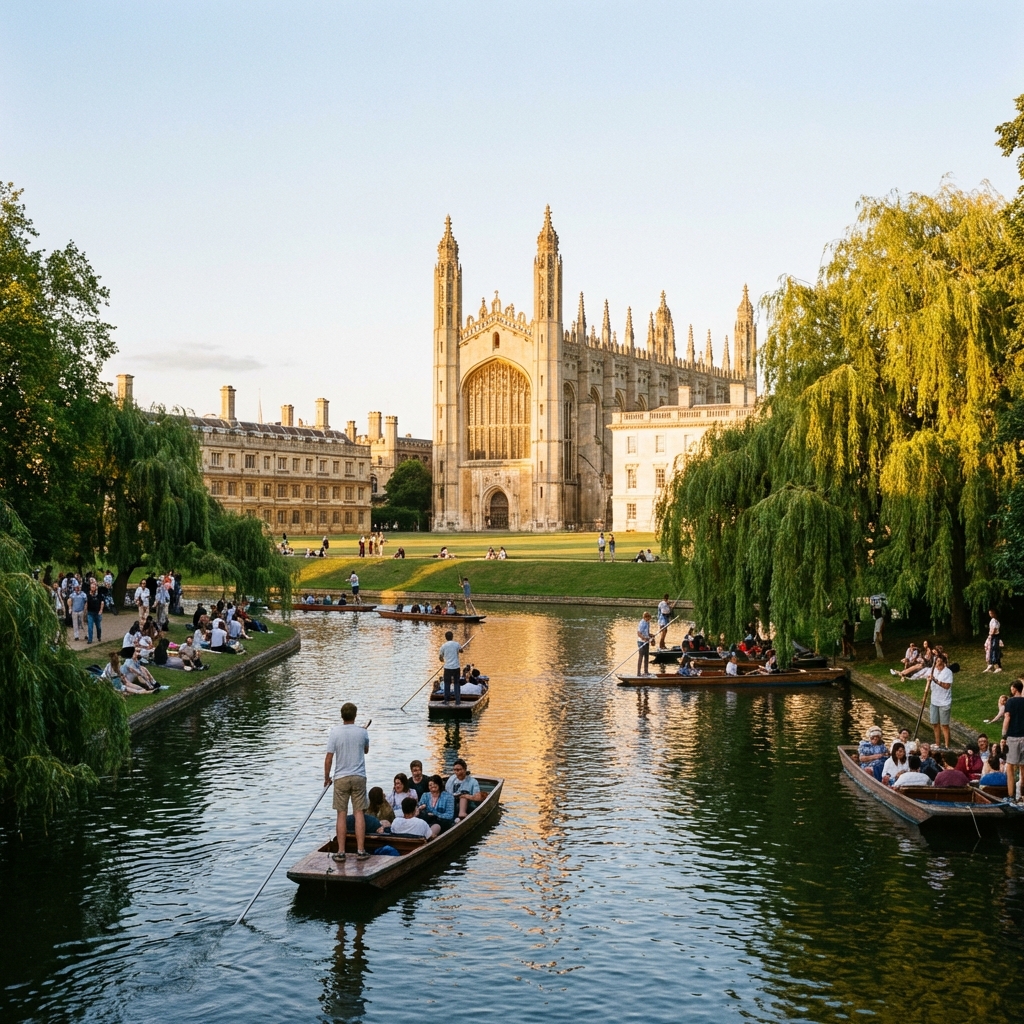
Punting—propelling a flat-bottomed boat with a long pole—is Cambridge's most iconic activity. It's also ridiculously difficult and joyfully silly.
The Backs: The stretch of River Cam behind several colleges (King's, Clare, Trinity, St. John's) offers:
- Stunning college views from the water
- Bridge of Sighs (St. John's College—named after Venice but looks nothing like it)
- Weeping willows, manicured lawns, Gothic spires
How to Punt:
Option 1: Hire a punt (self-propelled):
- £25-30 per hour
- Prepare to go in circles, hit the banks, and drop the pole
- Chauffeur hire available (student punter guides you): £80-100/hour
Option 2: Watch others struggle:
- Sit at The Mill pub garden and watch beginners crash into each other (equally entertaining, much cheaper)
Best punting companies:
- Scudamore's (established 1910, multiple locations)
- Cambridge Chauffeur Punts (students earn money guiding tourists)
Pro tip: If you self-punt, start from Magdalene Bridge (less crowded than Mill Lane). Pole from the back platform, not the side. Accept you'll be terrible. Embrace the chaos.
The Science City: Silicon Fen and Nobel Prizes
121 Nobel Laureates and Counting
Cambridge has produced 121 Nobel Prize winners—more than any other institution globally. The list is absurd:
Physics: Isaac Newton, Stephen Hawking, Ernest Rutherford (split the atom), J.J. Thomson (discovered the electron)
Chemistry: Dorothy Hodgkin (X-ray crystallography), Fred Sanger (DNA sequencing—won Nobel twice!)
Medicine: James Watson & Francis Crick (DNA structure), Ian Wilmut (Dolly the sheep cloning)
Economics: John Maynard Keynes (arguably the 20th century's most influential economist)
This isn't ancient history: Cambridge scientists continue winning Nobels regularly (2020: Roger Penrose, Physics; 2019: Michael Kremer, Economics).
Silicon Fen: Europe's Tech Powerhouse
Cambridge Science Park (est. 1970) sparked what's now called "Silicon Fen"—the nickname for Cambridge's science and technology cluster.
The numbers:
- 1,500+ tech companies in the Cambridge area
- £3.9 billion annual revenue from Cambridge tech cluster
- ARM Holdings (British chip designer powering most smartphones) originated in Cambridge
- AstraZeneca (pharmaceutical giant) has major Cambridge presence
- Microsoft Research, Amazon, Apple all have Cambridge labs
Why Cambridge? University research spins out into startups. Venture capital follows. Talent concentrates. Feedback loop created.
Cambridge vs. Oxford: While Oxford has prestigious humanities, Cambridge dominates STEM (science, technology, engineering, mathematics). Silicon Fen > Oxford science park.
The Eagle Pub: Where DNA Was Discovered
The Most Important Pub Announcement in History
The Eagle Pub (Bene't Street) is an unassuming medieval coaching inn (parts date to 1525). But on February 28, 1953, it became the site of science's greatest pub announcement.
James Watson and Francis Crick burst into the Eagle and declared they'd "discovered the secret of life"—DNA's double helix structure.
They were regulars at the Eagle (specifically the back room, now called the "DNA Room"). Over lunch and pints, they'd discuss research, scribble on napkins, theorize.
Today:
- The Eagle still operates as a pub (food mediocre, beer fine, history priceless)
- A blue plaque marks the DNA announcement
- The DNA Room in the back is preserved
- Ceiling covered in WWII graffiti (RAF and USAF airmen stationed nearby wrote names/squadron numbers in candle smoke)
Other Cambridge pubs worth visiting:
- The Free Press (hidden, tiny, no music, Victorian time capsule)
- The Maypole (student dive, cheap, lively)
- The St. Radegund (cozy, literary crowd)
Beyond Colleges: Cambridge's Independent Scene
The Junction: DIY Music Venue That Matters
If you only know Cambridge through tourism, you'd never guess it has one of the UK's best grassroots music venues.
The Junction (Clifton Road) is a DIY arts center/music venue that's hosted:
- Radiohead (early gigs)
- Arctic Monkeys (pre-fame)
- Amy Winehouse
- The Strokes
- Countless emerging acts
It also hosts comedy (Stewart Lee, James Acaster), theater, club nights.
Why it matters: Cambridge's wealth and conservatism could easily produce a sterile, corporate city. Instead, gritty independent venues like The Junction keep true creative culture alive.
The Cambridge Corn Exchange
Not to be confused with the modern Corn Exchange arts venue, the historic Corn Exchange (built 1875) now hosts:
- Live music (touring acts)
- Comedy shows
- Graduations
Architecture highlight: Stunning Victorian Gothic Revival building worth seeing externally.
Arts Picturehouse: UK's Best Independent Cinema
Arts Picturehouse might be the UK's finest independent cinema:
- Art-house films, foreign language cinema, classics
- Beautiful Edwardian building
- Central location (St. Andrew's Street)
- Café-bar with excellent atmosphere
Cambridge film culture: Multiple independent cinemas (Arts Picturehouse, Cambridge Film Festival) plus the university's active film societies create a city that takes cinema seriously.
Kettle's Yard: Hidden Art Gem
Kettle's Yard is Cambridge's best-kept secret—a house-museum filled with 20th-century art.
History:
Art collector Jim Ede (former Tate curator) filled four cottages with modern art, then opened his home to students and visitors (1957). Upon his death, he donated everything to Cambridge University.
What's there:
- Modern British art (Ben Nicholson, Barbara Hepworth, Henry Moore)
- Minimalist, calming spaces
- Still feels like a home, not a formal museum
Entry: Free
Why visit: Intimate, quiet, utterly unique art experience—total opposite of busy college tourism
Cambridge Market Square: 800 Years of Commerce
Forget the colleges for a moment—Cambridge Market (operating since at least 1200s) is where actual Cambridge life happens.
What's there:
- Mon-Sat daily market: Food, crafts, clothes, plants
- Surrounded by: Historic buildings (Great St. Mary's Church, Guildhall)
- Student/local mixing: Tourists avoid the market; locals shop here
Great St. Mary's Church:
Next to the market, this medieval church (rebuilt 1478-1608) has a tower you can climb (123 steps) for panoramic Cambridge views. £5 entry, worth it.
Cambridge's Cycling Culture: The Netherlands of England
Cambridge is England's most cycle-friendly city:
62% of residents commute by bike daily (UK's highest percentage)
130,000+ bikes in a city of 125,000 people (more bikes than people!)
Flat terrain makes cycling easy (Cambridge sits in the Fens—pancake-flat)
Why cycling matters:
- Defines Cambridge's character (students zoom past tourists on vintage bikes)
- Environmentally progressive (low car use)
- Creates egalitarian street life (everyone cycles—students, professors, locals)
Cycling tip: Hire a bike (£10/day) and explore like a local. Cambridge is small, flat, bike-lane-rich—perfect cycling city.
The Round Church: One of England's Four Circular Medieval Churches
The Church of the Holy Sepulchre (famously called "The Round Church") is one of only four circular medieval churches in England.
Built: Around 1130 (over 890 years old)
Style: Romanesque (rounded arches, thick walls)
Why circular: Modeled on the Church of the Holy Sepulchre in Jerusalem (Crusader influence)
Today: Visitor center with Cambridge history exhibits. £3 entry.
3 other circular churches in England:
- Temple Church, London
- Little Maplestead, Essex
- Northampton
Practical Guide: One Perfect Day in Cambridge
Morning (9am-12pm):
- King's College Chapel (arrive 9am, before crowds)
- Walk along The Backs (river path behind colleges)
- Round Church (quick history stop)
Lunch (12-1:30pm):
- Cambridge Market (grab street food)
- OR Fitzbillies Chelsea bun + coffee
Afternoon (1:30-5pm):
- Kettle's Yard (free, calming art)
- Trinity College Great Court and Wren Library
- OR Punt on the River Cam (1-2 hours)
Evening (5pm onward):
- Evensong at King's or St. John's (free, 5:30pm)
- Dinner: Independent restaurant
- The Eagle Pub (DNA room, WWII ceiling, historical pints)
Grantchester: The Perfect Village Escape
Just 3 miles southwest of Cambridge, Grantchester is a quintessential English village made famous by poets (Rupert Brooke, "The Old Vicarage, Grantchester").
The walk:
Footpath from Cambridge along the River Cam to Grantchester (45 minutes, flat, idyllic).
The destination:
The Orchard Tea Garden—outdoor tea garden where you sit in deck chairs under apple trees eating scones. Utterly, perfectly, absurdly English.
Cambridge students' tradition: Walk or cycle to Grantchester, have afternoon tea, return.
Conclusion: The City Beyond the Gowns
Cambridge's double life is its genius: world-famous university meets fiercely independent creative city.
Yes, the colleges are extraordinary—King's Chapel alone justifies Cambridge's global fame. But if you only see colleges, you're missing the real Cambridge: the pub where DNA was announced over pints, the music venues launching future headliners, the cycling commuters flowing like rivers, the market square unchanged in 800 years, Silicon Fen's labs advancing human knowledge, Kettle's Yard's quiet art sanctuary.
Cambridge isn't a museum. It's a living city where medieval foundations support cutting-edge science, where Nobel laureates cycle past students punting badly, where tradition and innovation aren't opposites—they're collaborators.
That's Cambridge beyond the colleges. And that Cambridge is extraordinary.
References and Resources
Official Tourism
Visit Cambridge: visitcambridge.org
Key Attractions
King's College Chapel: kings.cam.ac.uk/chapel
Kettle's Yard: kettlesyard.co.uk
The Round Church: roundchurch.org.uk
Music & Arts
The Junction: junction.co.uk
Arts Picturehouse: picturehouses.com/cinema/arts-picturehouse
Food & Drink
Fitzbillies: fitzbillies.com
The Eagle Pub: nicholsonspubs.co.uk/theeaglecambridge
Punting
Scudamore's Punting: scudamores.com
Featured Image Suggestion: King's College Chapel view from The Backs across the River Cam, with a punt in the foreground. Natural light, showcasing both iconic architecture and living Cambridge culture.
Timothy Canon
History & Literature CriticTimothy writes about history, literature, and the cultural threads that connect past and present.