
Norwich: England's Most Complete Medieval City
The Medieval City That Time Forgot to Ruin
Walk through Norwich and you're walking through remarkably intact medieval England. Thirty-two medieval churches still stand within the old city walls—more than any city outside London. A Norman cathedral with England's second-tallest spire. Cobbled lanes that've felt footsteps for 800+ years. A Norman castle keeping watch over the River Wensum.
But Norwich isn't a museum—it's a living,
breathing city of 144,000 people that happens to occupy one of England's best-preserved medieval streetscapes. It's also England's first UNESCO City of Literature (awarded 2012), a thriving creative hub, and home to the UK's longest-running outdoor market (900+ years old).
This is the paradox of Norwich: profoundly ancient yet vibrantly contemporary. Medieval churches host modern art installations. Cobbled medieval lanes house independent coffee shops and vintage boutiques. The city that was England's second-largest and wealthiest in medieval times (after London) still pulses with independent spirit, literary heritage, and creative culture.
The numbers tell Norwich's story: 32 medieval churches, 900-year-old market, 2 cathedrals, 140,000 residents, UNESCO City of Literature, 15,000+ students (University of East Anglia, Norwich University of the Arts), and remarkably, most of its medieval street plan intact.
This guide explores why Norwich deserves recognition as England's most complete medieval city—and why it's far more than just old buildings.
Why Norwich? Medieval Power and Wool Wealth
England's Second City (Medieval Era)
In medieval England (1066-1485), Norwich rivaled only London in size and wealth:
Population: By 1300, Norwich had 25,000+ residents—England's second-largest city (London: 80,000; Norwich: 25,000; York: 11,000; Bristol: 10,000)
Wealth: The surrounding Norfolk region produced England's finest wool, making Norwich staggeringly rich. Wool = medieval oil. Norwich merchants grew fantastically wealthy trading wool across Europe.
Strategic location: River Wensum flows into the Broads, connecting Norwich to the North Sea. Perfect for trade.
Church building boom: All that wool money funded church construction. Between 1066 and 1540, Norwich built 58 churches within the old walls. Today, 32 survive—an extraordinary preservation rate.
Norman Norwich: Cathedral and Castle
1066: William the Conqueror conquers England. By 1067, Normans begin building Norwich Castle—a massive keep designed to intimidate the conquered Anglo-Saxon population.
1096-1145: Construction of Norwich Cathedral. Anglo-Norman Romanesque architecture at its finest. The cathedral took nearly 50 years to complete.
Key fact: Norwich Castle and Norwich Cathedral are both Norman (built 1066-1154), making Norwich a showcase of Norman architecture—the style that defines medieval England's early period.
Norwich Cathedral: A Masterpiece of Norman Ambition
Architectural Marvel
Built: 1096-1145 (with later Gothic additions)
Style: Romanesque (rounded arches, massive walls) with Gothic modifications
Spire: 315 feet (96m)—England's second-tallest cathedral spire (after Salisbury, 404ft)
Length: 407 feet—one of England's longest cathedrals
What makes it special:
1. The Cloisters: Largest monastery cloisters in England. Two-story, magnificently preserved. Walk these quiet stone corridors and you're treading medieval monks' daily paths.
2. The Roof Bosses: Over 1,000 carved stone roof bosses (decorative ceiling knobs) depicting biblical stories. Installed 1297-1515. A complete medieval picture Bible carved in stone overhead.
3. The Spire: Rebuilt 1480 after lightning strike destroyed the original Norman spire. Soars 315 feet—visible across Norwich and the Norfolk countryside.
4. Living Cathedral: Still an active place of worship. Free entry (donations welcome). Evensong services maintain 900+ years of choral tradition.
Visitor tip: Don't miss the refectory (medieval dining hall, now café). Original 14th-century architecture, surprisingly good coffee.
Norwich Castle: Norman Power Made Stone
From Royal Palace to Museum
Built: 1067-1075
Function: Royal palace and fortification (later prison, now museum)
Architecture: Massive Norman keep—one of Europe's finest
Norwich Castle was built to project Norman power over a restive Anglo-Saxon population. It worked. The intimidating stone keep still dominates the hilltop.
What's inside today:
Norwich Castle Museum & Art Gallery:
- Medieval galleries: Armor, weapons, daily life artifacts
- Art collection: Norwich School paintings (19th-century landscapes)
- Natural history: Impressive collections
- Battlements tour: Climb to the top for panoramic Norwich views
Key fact: Unlike many ruined castles (looking at you, Warwick and Kenilworth), Norwich Castle is remarkably intact. The keep's exterior was refaced in the 1830s (slightly Victorian-ized), but the Norman structure survives essentially complete.
The 32 Medieval Churches: Norwich's Extraordinary Heritage
More Medieval Churches Than Anywhere But London
Why does Norwich have 32 surviving medieval churches?
1. Medieval wealth: Wool money funded massive church-building.
2. Small parishes: Medieval Norwich had 58 tiny parishes—some just 2-3 streets. Each needed a church.
3. Survival luck: Unlike London (Great Fire 1666, the Blitz), Norwich escaped catastrophic destruction. Churches survived.
4. Repurposing wisdom: Rather than demolish redundant churches, Norwich repurposed them. Today, medieval churches house:
- Arts centers (St. Gregory's Arts Centre)
- Antiques centers (St. Michael at Plea)
- Community spaces
- Coffee shops and event venues
Must-See Medieval Churches
St. Peter Mancroft:
Norwich's grandest parish church (cathedral aside). Perpendicular Gothic (1430-1455). Massive, light-filled, stunning.
St. John Maddermarket:
Medieval church now hosting Norwich Puppet Theatre—brilliant adaptive reuse.
St. Gregory's Arts Centre:
Medieval church-turned-gallery. Contemporary art in sacred space.
Octagon Chapel (technically not medieval, but worth noting):
Gorgeous 18th-century Nonconformist chapel. Stunning octagonal design.
The Norwich Lanes: Medieval Street Plan Alive Today
Elm Hill: Norwich's Most Photographed Street
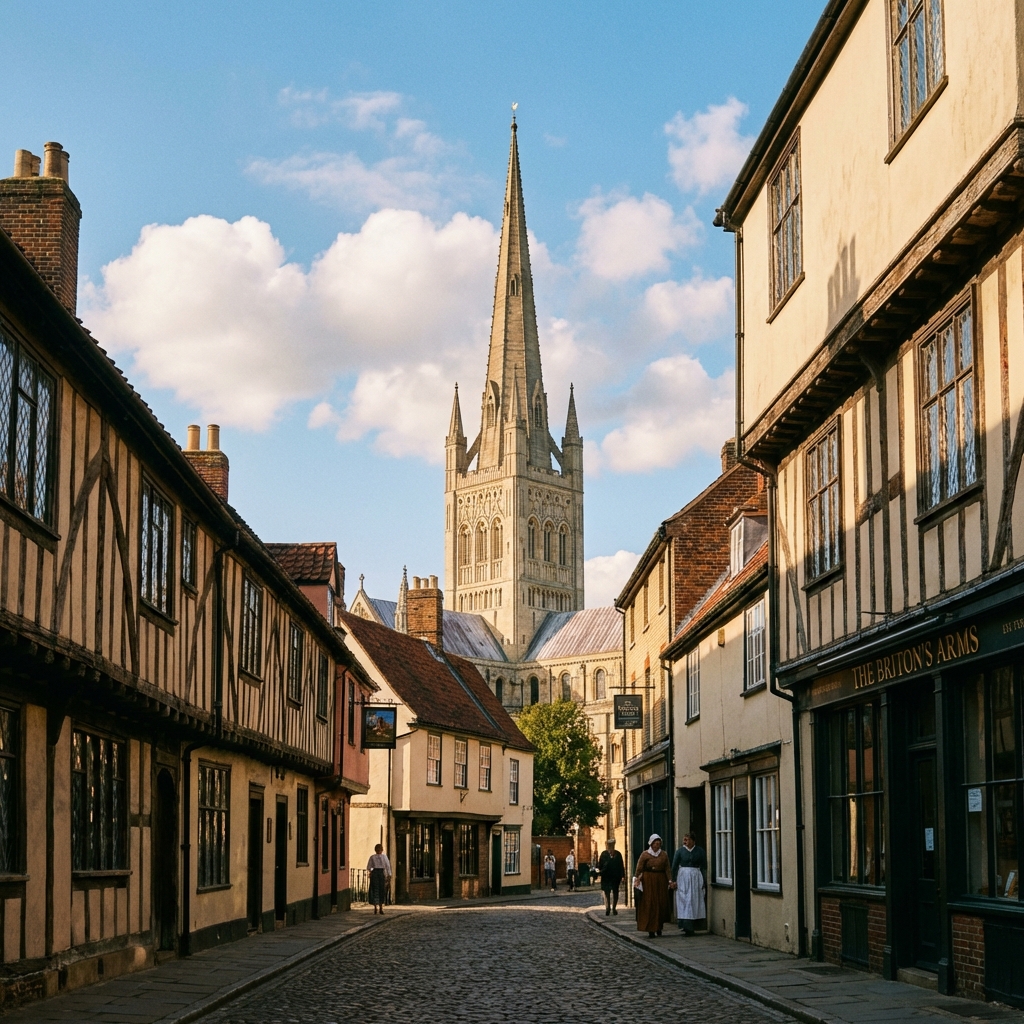
Elm Hill is the postcard-perfect medieval street:
- Cobblestones: Original medieval paving
- Timber-framed houses: Leaning, crooked, 500+ years old
- Independent shops: Antiques, galleries, crafts
- Tea rooms: Ye Olde English charm (but genuinely old!)
Elm Hill survived the Great Fire of Norwich (1507) which destroyed much of the city. Walk it today and you're seeing what medieval Norwich genuinely looked like.
The Lanes (Compact Medieval Street Grid)
Between Elm Hill and Gentleman's Walk, a maze of narrow lanes preserves Norwich's medieval street plan:
- Narrow, winding: Pre-planned before straight roads existed
- Independent shops: Vintage boutiques, record stores, cafés
- Creative businesses: Artists, designers, makers
This isn't Heritage England fakery—this is Norwich's actual medieval bones, repurposed for 21st-century independent retail.
Norwich Market: 900 Years of Commerce
UK's Longest-Running** Outdoor Market
Established: Around 1071 (900+ years old!)
Scale: 200 stalls, Monday-Saturday
Sells: Food, clothes, crafts, flowers, antiques
Norwich Market has operated on this spot for over 900 years—one of the longest continuously running outdoor markets in the UK. The current colorful striped awnings (installed 1930s, restored) are iconic.
What to buy:
- Local food: Norfolk produce, cheeses, baked goods
- International cuisine: Jamaican, Thai, Mexican street food
- Vintage clothes: Excellent second-hand finds
- Books, crafts, plants
The market is Norwich's beating heart—locals shop here daily. Utterly authentic, unpretentious, essential Norwich experience.
UNESCO City of Literature: Norwich's Literary Legacy
England's First UNESCO City of Literature (2012)
Norwich earned UNESCO City of Literature status in 2012—the first English city so designated (after Edinburgh, Melbourne, Iowa City, Dublin).
Why Norwich qualified:
1. Julian of Norwich (1342-1416):
Medieval anchoress (religious recluse) who wrote "Revelations of Divine Love"—the first book written by a woman in English. Lived in a cell attached to St. Julian's Church. Her "All shall be well, and all shall be well, and all manner of thing shall be well" is one of English literature's most famous lines.
2. UEA Creative Writing Program:
University of East Anglia established the UK's first Creative Writing MA in 1970. Alumni include Ian McEwan, Kazuo Ishiguro, Anne Enright, Tracy Chevalier—multiple Booker Prize winners.
3. Literary heritage:
- George Borrow (1803-1881): Travel writer, linguist, born Norwich
- Amelia Opie (1769-1853): Novelist, abolitionist
- Thomas Browne (1605-1682): Physician, philosopher, writer
4. Independent bookshops:
Norwich has more independent bookshops per capita than most UK cities. Jarrold & Sons (established 1823) is one of England's oldest department stores and booksellers.
5. Literary festivals:
Norfolk & Norwich Festival, Norwich Crime Writing Festival drawing international authors.
Where to Experience Literary Norwich
The Forum:
Modern library and cultural center (opened 2001). Millennium Library holds extensive Norfolk collections.
Norwich Cathedral Library:
Historic books, medieval manuscripts, quiet reading rooms.
Independent Bookshops:
- The Book Hive (Gentleman's Walk)
- City Bookshop
- Jarrold
University of East Anglia (UEA): Modernist Architecture Meets Medieval City
Britain's Most Distinctive Campus
UEA sits on Norwich's western edge—dramatically modernist 1960s-70s architecture (designed by Denys Lasdun) contrasting Norwich's medieval core.
Why it matters:
1. Creative Writing Powerhouse:
As mentioned, UEA's Creative Writing MA produced Ian McEwan, Kazuo Ishiguro, and dozens of acclaimed authors.
2. Sainsbury Centre for Visual Arts:
Stunning Norman Foster-designed gallery (1978) housing world-class art collection. Free entry. Modernist masterpiece.
3. Student population:
15,000+ students inject youth, energy, creativity into Norwich. Term-time, the city buzzes with student culture.
The Norwich School: Art and Landscape
Britain's First Provincial Art Movement
The Norwich School (1803-1833) was England's first regional art movement outside London:
Key artists:
- John Crome (1768-1821): "Old Crome" founded the Norwich Society of Artists (1803). Painted Norfolk landscapes influenced by Dutch masters.
- John Sell Cotman (1782-1842): Watercolorist, printmaker. Renowned for architectural drawings.
Legacy: Norwich Castle Museum holds the world's finest collection of Norwich School paintings. Their influence: celebrating local landscape, rejecting London-centric art world.
Norwich in the 21st Century: Creative Independent Spirit
Why Norwich Punches Above Its Weight
For a city of 144,000, Norwich has remarkable creative output:
1. Independent retail stronghold:
Norwich resisted chain-store homogenization better than most UK cities. The Lanes and city center remain fiercely independent—vintage shops, record stores, artisan cafés.
2. Music scene:
- Norwich Arts Centre: Intimate venue, legendary gigs
- UEA LCR: Hosted everyone from Joy Division to Arctic Monkeys
- Beth Orton, Cord (band), and others hail from Norwich
3. Norwich University of the Arts (NUA):
Specialist arts university (2,000+ students). Graphic design, fashion, fine art. Fuels Norwich's creative economy.
4. Food scene:
Norwich's independent restaurant/café culture rivals cities 3x its size:
- Grosvenor Fish Bar: Legendary fish & chips
- The Waffle House: Institution since 1949
- Namaste Village, Brick Pizza, Farmyard: Excellent independents
5. The Broads connection:
Norwich sits at the edge of the Norfolk Broads—125 miles of navigable waterways (Britain's largest protected wetland). Day trips, boating, nature escapes minutes from the medieval city center.
Practical Guide: Experiencing Norwich
Getting There
By Train:
- From London Liverpool Street: 1h 50min (direct)
- From Cambridge: 1h 10min
- From Ely: 40min
By Car:
- A11 from London (1h 50min)
- A47 from Peterborough/Midlands
Norwich Airport: Small regional airport, limited flights
What to See (One Perfect Day)
Morning (9am-12pm):
- Norwich Market breakfast (grab coffee, pastry)
- Norwich Cathedral (arrive when it opens, 9am, before crowds). Spend 90 minutes exploring cloisters, roof bosses, nave.
- Walk Elm Hill medieval street
Lunch (12-2pm):
- The Waffle House (1940s institution, sweet/savory waffles)
- OR Market food stalls (Thai, Jamaican, Mexican)
Afternoon (2-5pm):
- Norwich Castle Museum (allow 2 hours minimum)
- OR Sainsbury Centre for Visual Arts (UEA campus, Norman Foster building, world-class collection)
- Walk The Lanes (independent shops, galleries, cafés)
Evening (5pm onward):
- St. Gregory's Arts Centre or Norwich Arts Centre (check what's on)
- Dinner: Independent restaurant (Norwich excels at this)
- Pub: Adam and Eve (Norwich's oldest pub, 1249 AD) or Fat Cat Brewery Tap
Where to Stay
Budget: Travelodge, Premier Inn (city center locations)
Mid-Range: 38 St. Giles (boutique hotel, excellent location)
Splurge: The Assembly House (Georgian townhouse hotel, stunning)
Unique: The Maids Head Hotel (claims to be Norwich's oldest hotel, parts 13th century)
When to Visit
Best: May-September (warmest, longest days, outdoor events)
Norfolk & Norwich Festival: May (two-week arts festival, major event)
Christmas Markets: December (Norwich's medieval streets perfect for festive markets)
Avoid: January-February (coldest, shortest days)
Beyond Norwich: The Norfolk Broads
Britain's Magical Waterways (15 Minutes From City Center)
The Norfolk Broads—125 miles of navigable rivers and lakes—are a 15-minute drive from Norwich city center:
What they are:
Medieval peat excavations flooded in the 13th-14th centuries, creating a vast network of waterways. Think English mini-Venice, but rural, wild, teeming with wildlife.
What to do:
- Boat hire: Day boats, week-long cruisers
- Cycling: Flat, scenic trails
- Wildlife: Otters, kingfishers, rare butterflies
- Waterside pubs: Moor at riverside taverns
Why it matters: Norwich offers both medieval city immersion AND natural landscape escape within minutes. Rare combination.
Conclusion: The Medieval City That Lives
Norwich's magic isn't that it's old—plenty of English cities are old. Norwich's magic is that it's old and alive. The medieval street plan houses contemporary independent businesses. The 900-year-old market sells Thai street food alongside Norfolk vegetables. Medieval churches host art galleries and puppet theaters.
This is heritage done right: not preserved in amber, but adapted, reused, integrated into living culture.
Norwich never needed to become London. It was England's second city once, then trade routes shifted, industrialization favored other regions, and Norwich... stayed Norwich. Quietly literary, fiercely independent, profoundly itself.
Walk Elm Hill's cobblestones. Gaze up at Norwich Cathedral's second-tallest spire. Browse the 900-year-old market. Drink in a pub older than most European countries.
Then realize: this isn't a museum. This is just Norwich being Norwich.
That's the quiet miracle.
References and Resources
Essential Websites
Visit Norwich:
visitnorwich.co.uk - Official tourism site, events, accommodation
Norwich Cathedral:
cathedral.org.uk - Opening times, services, history
Norwich Castle Museum:
museums.norfolk.gov.uk - Exhibitions, collections, visiting info
Norfolk & Norwich Festival:
nnfestival.org.uk - Annual May arts festival (major event)
Books
"The Norwich School" by Andrew W. Moore
Comprehensive guide to Norwich's 19th-century art movement
"Revelations of Divine Love" by Julian of Norwich
Medieval mysticism, first book by a woman in English (modern translation recommended)
"Norwich: The Biography" by Michael Chandler
Historical deep-dive into Norwich's evolution
Museums & Galleries
Sainsbury Centre for Visual Arts (UEA campus)
Norman Foster building, world-class collection, free entry
scva.ac.uk
The Forum/Millennium Library:
Free library, Norfolk Heritage Centre, café
theforumnorwich.co.uk
Dragon Hall:
Medieval merchant's trading hall (restored)
dragonhall.org
Independent Bookshops
The Book Hive: King Street
City Bookshop: Davey Place
Jarrold: Historic department store/bookseller
Local Food & Drink
Grosvenor Fish Bar: Upper St. Giles (legendary fish & chips)
The Waffle House: St. Giles (since 1949, institution)
Adam and Eve: Bishopgate (Norwich's oldest pub, 1249)
Fat Cat Brewery Tap: West End Street (real ale paradise)
Getting Around
Norwich is walkable: City center exploring done on foot
Park & Ride: Multiple locations around city (cheap, efficient)
Local buses: FirstBus Norwich network
Bike hire: Beryl Bikes (dockless bike-share scheme)
Featured Image Suggestion: Norwich Cathedral with the spire dominating the skyline, taken from the riverside with cobbled street in foreground. Natural light, showcasing both medieval grandeur and living city atmosphere.
Timothy Canon
History & Literature CriticTimothy writes about history, literature, and the cultural threads that connect past and present.