
Ipswich: Waterfront Renaissance

The Comeback Town Nobody's Watching
Ipswich doesn't grab headlines. It's not Bristol's cool creative hub, not Brighton's bohemian beach town, not Cambridge's prestigious university powerhouse. For decades, Ipswich was... overlooked. The butt of jokes. A town past its prime, its medieval wool wealth long faded, its industrial docks shuttered, its town center tired.
But something's happening on the River Orwell waterfront.
A £1 billion+ regeneration project is transforming Ipswich's historic docks into a vibrant mixed-use waterfront. The University of Suffolk (established 2016) brings 10,000+ students and academic energy. DanceEast—one of the UK's leading national dance organizations—anchors a growing arts scene. Independent businesses are moving into renovated Victorian warehouses. The Waterfront district hums with restaurants, cafés, galleries, and a genuine sense of optimism.
The numbers tell Ipswich's transformation: 144,000 residents, £1 billion waterfront investment, University of Suffolk (10,000+ students), DanceEast national arts venue, 12th-century Ancient House (stunning Tudor pargeting), oldest Christian site in England (St. Peter's Church foundation), and a medieval street plan still visible in the town center.
This isn't "hidden gem" tourism marketing. This is a genuine story of a post-industrial town reinventing itself through education, culture, and smart urban regeneration—quietly, without fuss, doing the work.
This guide explores Ipswich's waterfront renaissance, medieval heritage, arts transformation, and why this overlooked Suffolk town deserves attention.
Ipswich History: From Anglo-Saxon Power to Medieval Wool Wealth
England's Oldest Continuously Settled Town
Ipswich claims to be England's oldest continuously settled town—archaeological evidence shows settlement from the 7th century AD (Anglo-Saxon era).
by 700-800 AD, Ipswich was a significant Anglo-Saxon trading port called "Gipeswic". Pottery made here (Ipswich ware) has been found across England and Europe—evidence of thriving trade.
Medieval Wool Trade: Ipswich's Golden Age
12th-15th centuries: Ipswich became one of England's wealthiest towns through the wool trade.
East Anglia (Suffolk, Norfolk) produced England's finest wool. Ipswich's port on the River Orwell (connected to the North Sea) made it the perfect export hub. Wool flowed through Ipswich to Europe—especially Flanders (modern Belgium/Netherlands), where it was woven into luxury cloth.
Evidence of wealth:
- 12 medieval parish churches built in Ipswich (many survive
)
- Ancient House (built 1567, but wealth from earlier wool trade funded such buildings)
- Town walls and defenses (fragments survive)
- Wolsey's Gate (remnant of Cardinal Wolsey's intended college—he was born in Ipswich!)
Cardinal Wolsey: Ipswich's Most Famous Son
Thomas Wolsey (1473-1530) was born in Ipswich to a butcher father. He rose to become:
- Lord Chancellor of England
- Cardinal (second-most powerful Catholic in England after the Archbishop of Canterbury)
- King Henry VIII's chief minister
Wolsey planned to build a grand college in his hometown (Wolsey's College). Only the gateway survives—Wolsey's Gate on College Street.
Decline and Industrial Era
After the medieval wool trade declined (16th-17th centuries), Ipswich's fortunes faded. The town remained a regional market center but lost its national importance.
Victorian era: Ipswich developed industries:
- Ransomes, Sims & Jefferies (agricultural machinery—lawnmowers!)
- Fisons (fertilizer company)
- Milling, malting, brewing
20th century decline: Deindustrialization hit Ipswich hard. Docks fell silent. Industries closed. The waterfront became derelict.
Then came the renaissance.
The Waterfront Renaissance: £1 Billion Transformation
From Derelict Docks to Vibrant District
Ipswich's Waterfront district transformation began in the 1990s-2000s and accelerated in the 2010s-2020s.
What's happened:
1. University of Suffolk (est. 2016):
The waterfront campus brought 10,000+ students, academic energy, and youthful demographics to a previously aging town. Students live, study, eat, socialize on the waterfront—instant vibrancy.
2. Residential Development:
Hundreds of new waterfront apartments. Converted Victorian warehouses. Modern builds with river views. Young professionals and families moving in.
3. Cultural Venues:
- DanceEast (Jerwood DanceHouse opened 2010): National dance organization, performances, classes, grassroots to professional
- Waterfront arts venues, galleries
4. Dining & Leisure:
Independent restaurants, cafés, bars lining the marina. The Waterfront complex (venue for gigs, events). Outdoor seating, river views, buzz.
5. Public Realm Improvements:
Paved walkways, sculpture, lighting, benches. The waterfront is now a place to stroll, not avoid.
Investment: Over £1 billion public and private investment across 20+ years.
The result: A district that 25 years ago was empty warehouses and crumbling docks is now Ipswich's beating heart—students, families, tourists, locals all mixing.
University of Suffolk: Education-Led Regeneration
Established: 2016 (gained full university status; existed as University Campus Suffolk from 2007)
Students: 10,000+
Campus: Waterfront location in converted and new buildings
Why it matters:
Universities transform places. They bring:
- Young population (reversing aging demographics)
- Economic activity (students spend money locally)
- Cultural vibrancy (events, societies, nightlife)
- Graduate retention (some stay post-graduation, starting careers/families locally)
Ipswich's waterfront campus model—rather than traditional isolated campus—integrates students into town life. They live in waterfront apartments, eat at town-center restaurants, use local services.
Similar success stories: Salford (Media City + university), Hull (university-led city of culture), Portsmouth (waterfront university regeneration).
DanceEast: Arts-Led Transformation
DanceEast is one of the UK's eight National Portfolio Dance Organizations (funded by Arts Council England as nationally significant).
Jerwood DanceHouse (opened 2010):
Purpose-built £6 million dance center on the waterfront:
- Professional dance studios
- 200-seat theater
- Classes for all ages/abilities (babies to seniors)
- Professional artist residencies
Why dance?
DanceEast's model: use dance as community development. Classes for disadvantaged communities, older people, people with disabilities. Dance as health, social connection, joy—not just elite performance.
National reputation:
DanceEast hosts touring companies, develops emerging choreographers, runs flagship programs like Boys Dancing (encouraging boys into dance, challenging stereotypes).
Impact on Ipswich:
Arts organizations like DanceEast:
- Attract creative professionals (choreographers, dancers, teachers moving to Ipswich)
- Create cultural tourism (people travel for performances)
- Signal "this town values culture"—psychological shift
Medieval Ipswich: What Survives
The Ancient House: Tudor Magnificence
The Ancient House (also called Sparrowe's House) on the Buttermarket is Ipswich's most photographed building—and for good reason.
Built: Around 1567 (Tudor era)
Famous for: Pargeting—elaborate decorative plasterwork on the exterior
The pargeting depicts:
- Four continents (Europe, Asia, Africa, America—the known world in Tudor England)
- Classical figures, coats of arms, ornate patterns
Remarkably intricate for a merchant's house—testament to medieval Ipswich's wealth.
Today:
Ground floor: Retail
Upper floors: Lakeland shop (kitchenware)
Free to view externally (façade is the attraction)
Ipswich's 12 Medieval Churches
Like Norwich, Ipswich has an impressive number of surviving medieval churches—12 within the historic town center.
Why so many?
Medieval wealth funded multiple parish churches serving tiny parishes (sometimes just a few streets).
Notable churches:
St. Mary-le-Tower:
Ipswich's civic church, stunning Perpendicular Gothic tower
St. Peter's Church:
On the site of England's oldest Christian foundation (claimed to be built on a Roman church site—disputed but possible)
St. Margaret's Church:
Beautiful medieval double hammerbeam roof
Adaptive reuse:
Not all 12 are active churches—some repurposed as community centers, offices, or closed.
Wolsey's Gate
The fragmentary remains of Cardinal Wolsey's College—a gateway on College Street.
Wolsey planned a grand educational institution in his hometown but fell from power before completing it. Only the ornate brick Tudor gateway survives—a poignant memorial.
Christchurch Mansion and Park
Christchurch Mansion (built 1548-50) is a Tudor mansion in a gorgeous 70-acre park (Christchurch Park).
What's inside:
- Period rooms (Tudor through Victorian)
- Art collection:
- Suffolk artists (especially Constable and Gainsborough—both born in Suffolk)
- Largest collection of Constable paintings outside London
- Gainsborough portraits
Entry: Free
Why visit: Beautiful historic house, excellent art (especially if you love Constable), lovely park for walks
Christchurch Park:
70 acres of rolling parkland, ancient trees, ponds, wildlife. Locals' favorite green space.
Ipswich Creative Scene: Beyond the Waterfront
Independent Retailers: St. Nicholas Street and St. Peter's Street
The historic town center lanes (particularly St. Nicholas Street and St. Peter's Street) are seeing independent retail growth:
- Vintage shops
- Record stores
- Art galleries
- Independent cafés
Not yet Norwich or Cambridge levels, but genuine momentum.
The Waterfront: Live Music Venue
The Waterfront (Shed 17, Neptune Quay) is Ipswich's main grassroots music venue:
- Indie, rock, punk, electronic gigs
- 200-300 capacity
- Hosted early-career bands (acts before they break nationally)
Why it matters: Small towns need venues like this or music culture dies. The Waterfront keeps Ipswich connected to national touring circuits.
Ipswich Film Theatre
Independent cinema showing art-house films, foreign language cinema, classics.
Located in the Town Hall basement (quirky location!), it's a volunteer-run gem keeping film culture alive.
Brazier's Wood: Ipswich's Sculpture Park
Just outside Ipswich, Brazier's Wood is a woodland sculpture park:
- 18 acres of woodland
- Contemporary sculptures by UK artists
- Free to wander
A lovely, unexpected surprise.
Ipswich Food & Drink
Waterfront Dining
The marina/waterfront has dozens of restaurants and cafés:
- Mariners (seafood)
- Cult Café (brunch, lunch, coffee)
- Zest (Thai)
- Chain options plus independents
Vibe: Relaxed, family-friendly, outdoor seating, river views
The Brewery Tap
Ipswich has brewing heritage—Tolly Cobbold brewery operated for centuries (closed 2002, site now housing).
Brewery Tap (Cliff Quay) revives brewing tradition: craft beers, riverside location, live music.
Buttermarket Coffee
Independent café in the Buttermarket (near Ancient House). Excellent coffee, pastries, local vibe.
Orwell Country: Constable and Gainsborough Landscapes
Ipswich sits in Suffolk—the county that produced two of England's greatest landscape painters:
John Constable (1776-1837):
Born in East Bergholt (10 miles south of Ipswich). Painted the Suffolk countryside obsessively—Flatford Mill, The Hay Wain, Dedham Vale.
Thomas Gainsborough (1727-1788):
Born in Sudbury (15 miles northwest of Ipswich). Famous for portraits but started as a landscape painter of Suffolk scenes.
Orwell Country:
The countryside around Ipswich—especially the River Orwell estuary and Dedham Vale—is Constable country. You can walk landscapes he painted.
Constable Trail:
Well-signposted walking routes through Constable's Suffolk (Flatford, East Bergholt, Dedham).
Day trips from Ipswich:
- Flatford Mill (NT site, The Hay Wain location)
- Dedham
- Lavenham (stunning medieval wool town, half-timbered perfection)
Practical Guide: Visiting Ipswich
Getting There
By Train:
- From London Liverpool Street: 1h 10min (direct, frequent)
- From Cambridge: 50 minutes
- From Norwich: 45 minutes
- From Colchester: 20 minutes
By Car:
- A12 from London (1h 30min)
- A14 from Cambridge (50 min)
One Perfect Day in Ipswich
Morning (9:30am-12pm):
- Christchurch Mansion (free, Constable paintings, beautiful rooms)
- Walk through Christchurch Park
- Ancient House (view pargeting on Buttermarket)
Lunch (12-1:30pm):
- Waterfront café (Cult Café or similar)
- OR Buttermarket Coffee
Afternoon (1:30-5pm):
- Waterfront walk (marina, University of Suffolk campus, public art)
- Ipswich Museum (free, natural history, Anglo-Saxon Ipswich ware)
- St. Mary-le-Tower Church (if open)
- OR DanceEast (check if classes/performances on)
Evening:
- Dinner: Waterfront restaurant
- Drink: Brewery Tap or town-center pub
- Live music: Check The Waterfront schedule
When to Visit
Best: May-September (warmest, waterfront outdoor seating pleasant)
Events: Ip-Art festival (various dates, arts across town)
Avoid: January-February (coldest)
Where to Stay
Budget: Travelodge, Premier Inn
Mid-Range: Salthouse Harbour Hotel (waterfront, smart)
Boutique: Look at converted waterfront buildings (Airbnb options)
Suffolk Day Trips from Ipswich
Woodbridge (8 miles northeast)
Charming market town on the River Deben:
- Tide Mill (working 18th-century tide mill)
- Antique shops, cafés
- Sutton Hoo (Anglo-Saxon burial site—King's treasure, Netflix film "The Dig")—nearby
Lavenham (20 miles northwest)
England's best-preserved medieval wool town:
- Hundreds of half-timbered buildings
- Lavenham Guildhall (National Trust)
- Crooked House (impossibly tilted Tudor building)
Worth the drive: Absolutely
Aldeburgh (25 miles northeast)
Coastal town famous for:
- Benjamin Britten (composer, founded Aldeburgh Festival)
- Fish and chips (best on the beach)
- Pebble beach, coastal walks, art galleries
Conclusion: The Quiet Transformation
Ipswich's renaissance won't make international headlines. There's no Bilbao-Guggenheim moment, no Olympics-driven regeneration, no flashy celebrity investment.
Instead, Ipswich is doing something rarer: steady, thoughtful, community-focused transformation. A university brings students. An arts organization (DanceEast) brings culture and national reputation. Waterfront investment creates mixed-use vibrancy. Independent businesses move in. Slowly, confidence returns.
This is regeneration done right—not gentrification pushing out locals, but local-led growth that celebrates heritage (Ancient House, medieval churches, Cardinal Wolsey) while building new identity (education town, arts center, waterfront living).
Ipswich won't become Cambridge or Norwich. It doesn't need to. It's becoming the best version of itself: a medium-sized Suffolk town with medieval bones, creative energy, waterfront views, and a stubborn determination to prove doubters wrong.
Walk the waterfront at sunset. Visit DanceEast. See Constable's Suffolk at Christchurch Mansion. Eat well. Notice the optimism.
That's Ipswich's renaissance. Quiet. Real. Worth watching.
References and Resources
Official Tourism
Visit Ipswich: visit-ipswich.com
Events, attractions, accommodation
Discover Suffolk: discoversuffolk.org.uk
Wider Suffolk tourism information
Key Attractions
Christchurch Mansion: cimuseums.org.uk/visit/christchurch-mansion
Free entry, Constable collection, historic house
DanceEast: danceeast.co.uk
Classes, performances, events
Ipswich Museum: cimuseums.org.uk/visit/ipswich-museum
Free entry, local history, Anglo-Saxon Ipswich
University
University of Suffolk: uos.ac.uk
Student city, waterfront campus
Food & Drink
Cult Café: (waterfront)
Brewery Tap: brewerytap-ipswich.co.uk
Mariners: (waterfront seafood)
Day Trips
Sutton Hoo (National Trust): nationaltrust.org.uk/sutton-hoo
Anglo-Saxon burial site, 30min drive
Lavenham (medieval wool town): lavenham.co.uk
20 miles northwest, stunning half-timbered architecture
Flatford Mill (Constable country): nationaltrust.org.uk/flatford
The Hay Wain location, 10 miles south
Getting There
Greater Anglia trains: greateranglia.co.uk
London, Cambridge, Norwich connections
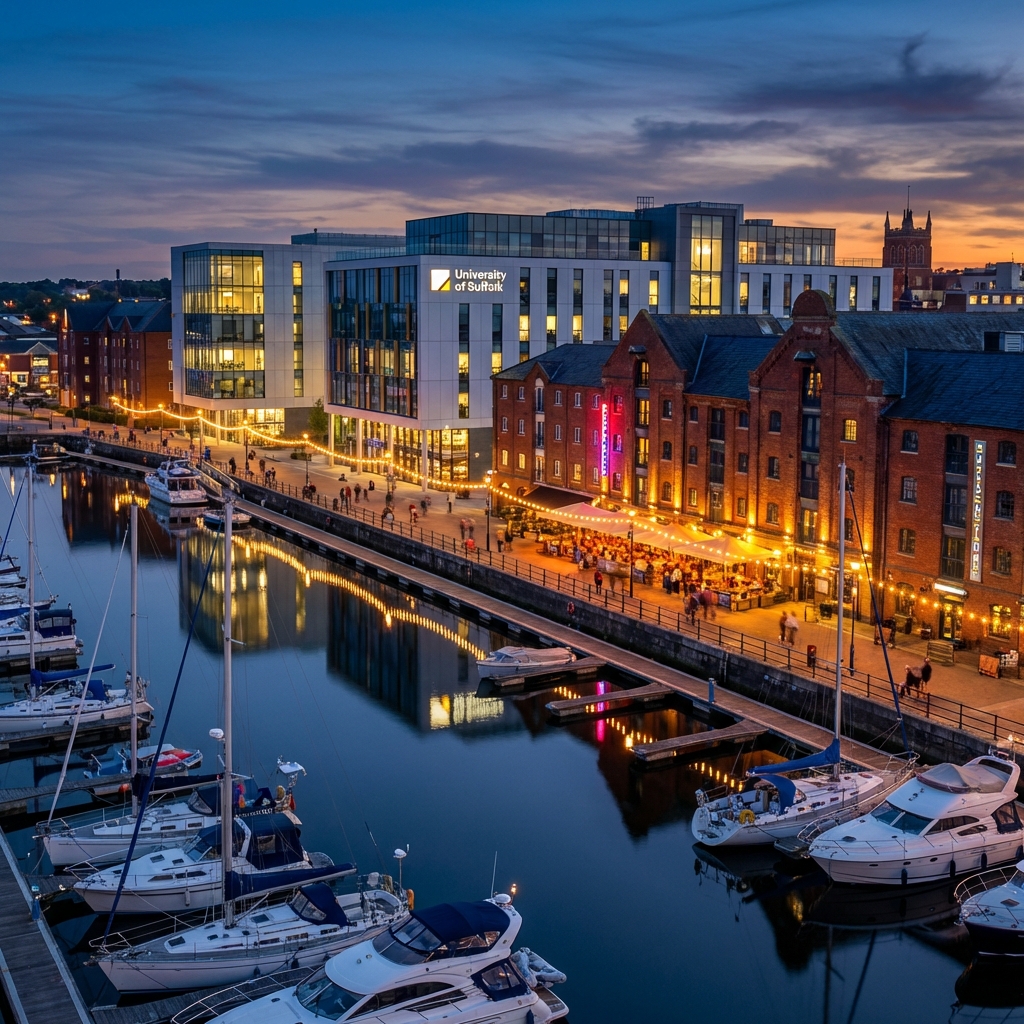
Featured Image Suggestion: Ipswich Waterfront at golden hour—marina with boats, University of Suffolk buildings, people walking/cycling along the waterfront path. Warm light, sense of vibrancy and transformation.
Ruth Naomi
Community & Lifestyle LeadRuth is passionate about uncovering the stories that connect communities and celebrate local culture.