

Flower Arranging: From Japanese Ikebana to British Garden Style

An Ancient Art Meets Modern Mindfulness
Walk past any florist and you'll see them: perfectly arranged bouquets in predictable vases, wrapped in cellophane, designed to be bought, admired briefly, then discarded. But flower arranging—true flower arranging—is something far more profound than supermarket bouquets.
It's an ancient art practiced in Egyptian tombs, refined in Japanese Zen temples, celebrated in Dutch Golden Age paintings, and whispered through Victorian coded messages. Today, it's experiencing a quiet renaissance as people rediscover what cultures have known for millennia: arranging flowers isn't just decoration. It's meditation, creativity, nature connection, and a tangible link to beauty in an increasingly digital world.
From the stark minimalism of Japanese Ikebana (where empty space speaks as loudly as blossoms) to the abundant, romantic chaos of British cottage garden style, flower arranging offers something rare: a craft equally accessible to complete beginners and lifelong practitioners, equally suited to quiet contemplation and joyful expression.
This guide explores flower arranging across
cultures and centuries—from ancient traditions to modern sustainability, from your first simple arrangement to growing your own cutting garden.
Flowers Through History: A Global Story
Ancient Beginnings
Ancient Egypt (3000-30 BC):
Lotus flowers arranged in tombs weren't mere decoration—they carried spiritual significance, symbolizing rebirth and the cycle of life. Archaeologists have found preserved flower arrangements in pharaohs' burial chambers, testimony to humanity's ancient urge to honor death and celebration with blooms.
Ancient Greece and Rome:
Garlands and wreaths adorned ceremonies, festivals, and symposia. Flowers symbolized everything from athletic victory to religious devotion.
Japanese Ikebana: The Way of Flowers
In 15th-century Japan, Buddhist monks developed Ikebana (literally "living flowers")—transforming flower arranging into a disciplined spiritual practice.
Unlike Western arrangements emphasizing abundance, Ikebana celebrates:
- Minimalism: A single branch can be enough
- Asymmetry: Natural, not forced balance
- Space: Empty space (ma) is as important as the flowers
- Three elements: Heaven (shin), Earth (soe), Human (hikae) creating harmony
Major Ikebana schools:
- Ikenobo (oldest, founded 15th century)
- Ohara (developed naturalistic landscape style)
- Sogetsu (modern, abstract, avant-garde)
Ikebana remains a meditative practice today, with schools and practitioners worldwide.
Dutch Golden Age: Flowers as Wealth
In 17th-century Netherlands, flowers became symbols of prosperity and transience. Painters like Jan Brueghel and Rachel Ruysch created opulent still-life paintings featuring exotic tulips, roses, and peonies—often flowers that bloomed in different seasons, impossibly united in a single vase.
The famous Tulip Mania (1636-1637) saw single tulip bulbs selling for more than houses—an economic bubble built on flowers.
Victorian Language of Flowers
Victorian England developed floriography—an elaborate coded language using flowers to communicate sentiments proper society couldn't speak aloud.
Common Victorian flower meanings:
- Red rose = passionate love
- Yellow rose = friendship (or jealousy!)
- White lily = purity
- Lavender = devotion
- Forget-me-not = true love, remembrance
Entire books cataloged flower meanings, allowing (particularly) women to send covert messages through carefully chosen bouquets.
British Garden Style: Natural Abundance
Moving into the 20th century, British flower arranging embraced a looser, more natural aesthetic influenced by cottage gardens.
Gertrude Jekyll (1843-1932), the legendary garden designer, championed informal, abundant plantings that felt organic rather than manicured. Modern practitioners like Sarah Raven and Pippa Drummond continue this tradition: garden-fresh flowers arranged with joyful abandon.
Four Distinct Arranging Styles
Ikebana (Japanese Minimalism)
Philosophy: Less is more. Space speaks. Every stem intentional.
Technique:
- Asymmetrical three-point structure (Heaven, Earth, Human)
- Kenzan (metal pin frog) holds stems in place
- Often 3-5 stems total
- Emphasis on line, movement, negative space
Feeling: Contemplative, meditative, Zen. Each arrangement is a moment of mindfulness.
Western Garden Style (British Abundance)
Philosophy: Celebrate abundance, natural beauty, seasonal bounty.
Technique:
- Loose, organic, slightly chaotic
- Varying heights and textures
- Seasonal British flowers and foliage
- "Just-picked-from-the-garden" aesthetic
Feeling: Joyful, romantic, nostalgic. Cottage garden charm.
Classic/Formal (Traditional Elegance)
Philosophy: Balance, symmetry, refined sophistication.
Technique:
- Structured, often triangular or round shapes
- Formal flowers: roses, lilies, orchids
- Precise placement, even distribution
- Often used floral foam for structure
Feeling: Weddings, events, formal occasions. Timeless elegance.
Modern/Contemporary (Bold Statements)
Philosophy: Break the rules. Create sculptural, architectural arrangements.
Technique:
- Unexpected materials: branches, grasses, succulents, even vegetables
- Bold color blocks or monochromatic palettes
- Dramatic scale or unusual containers
- Instagram-worthy statement pieces
Feeling: Artistic, avant-garde, conversation-starting.
Seasonal British Flowers: What Blooms When
Spring (March-May)
The season of bulbs:
- Daffodils (classic British spring)
- Tulips (hundreds of varieties)
- Hyacinths (intensely fragrant)
- Ranunculus (paper-thin petals, jewel tones)
- Anemones
- Cherry and apple blossoms
- Bluebells (foraged responsibly from woodlands)
Colors: Pastels, fresh yellows, soft pinks, pure whites
Summer (June-August)
Peak flower season:
- Roses (the queen of flowers)
- Peonies (June only—fleeting, divine, expensive)
- Sweet peas (fragrant cottage garden favorite)
- Delphiniums (tall, stately spires)
- Foxgloves
- Dahlias (late summer through autumn)
- Zinnias, cosmos, sunflowers
Colors: Vibrant, saturated, full spectrum
Autumn (September-November)
The season of texture:
- Dahlias (continue from summer, peak productivity)
- Chrysanthemums
- Seed heads (alliums, teasels, grasses)
- Autumn foliage (turning leaves)
- Berries (rosehips, hawthorn, rowan)
- Late roses
Colors: Rust, orange, burgundy, deep pinks
Winter (December-February)
Challenging but beautiful:
- Hellebores (Christmas rose—blooms in snow)
- Evergreen foliage (holly, ivy, pine, eucalyptus)
- Forced bulbs (amaryllis, paperwhites for indoors)
- Dried flowers and seed heads
- Winter jasmine
Colors: Whites, silvers, deep greens
Pro tip: British flowers in winter are limited—this is when sustainability matters most. Choose evergreens and dried over imported blooms.
Getting Started: Basic Techniques
Essential Supplies (£15-20)
Vase:
Start with a simple cylinder, 6-8 inches tall. Clear glass lets you see stems (helpful for beginners).
Sharp scissors or secateurs:
Buy proper flower scissors (£5-10). Clean, angled cuts help flowers absorb water.
Flower food:
Those little packets actually work—they feed flowers and inhibit bacteria. Or make your own: 1 tsp sugar + few drops bleach in water.
Optional but helpful:
- Chicken wire (eco alternative to floral foam)
- Flower frog/kenzan for Ikebana
- Various height vases
The 7 Fundamental Steps
1. Prepare your vase:
Wash thoroughly (bacteria kills flowers faster than anything). Fill with fresh, cool water.
2. Condition your flowers:
- Remove all leaves that will sit below water line (bacteria source)
- Cut stems at 45-degree angle underwater if possible
- Let flowers drink deeply for 2+ hours before arranging
3. Start with greenery:
Create a structure/framework with foliage. This gives you something to nestle flower stems into.
4. Add focal flowers first:
Place your largest, showiest blooms (roses, peonies, dahlias) first. These anchor the arrangement.
5. Fill gaps with smaller flowers:
Add secondary blooms and texture between focal flowers.
6. Step back and assess:
Rotate your vase. Does one side feel bare? Too crowded? Adjust.
7. Maintain:
- Top up water daily
- Change water completely every 2-3 days
- Re-cut stems when changing water
- Remove any dying blooms immediately
Golden Rules for Pleasing Arrangements
Odd numbers: 3, 5, 7 flowers look more natural than even numbers
Vary heights: Create visual interest by cutting stems different lengths
Triangle principle: Base should be wider than top (creates stability and pleasing proportions)
Color harmony:
- Monochromatic: shades of one color (elegant, sophisticated)
- Analogous: colors next to each other on color wheel (harmonious)
- Complementary: opposite colors (purple + yellow, red + green—bold!)
British Garden Style: A Step-by-Step Guide
This is the most forgiving, joyful style for beginners.
What You'll Need
- Vintage jug, jam jar, or simple ceramic vase
- Garden flowers in varying heights (or market bunch + garden greenery)
- Scissors
The Process
1. Choose your container: Rustic, simple containers suit this style. Mason jars, vintage jugs, ceramic pitchers all work beautifully.
2. Gather varying heights:
- Tall (delphiniums, foxgloves, flowering branches)
- Medium (roses, dahlias, peonies)
- Short (violas, small dahlias, herbs)
3. Strip lower leaves: Clean stems of any foliage that would sit in water.
4. Start with structure: Place tallest stems at the back. Add foliage throughout to create a loose framework.
5. Add focal blooms: Nestle 3-5 roses or dahlias throughout—not in a perfect line, but naturally scattered.
6. Fill organically: Tuck smaller flowers, herbs, grasses between larger blooms. Don't overthink placement.
7. Embrace imperfection: This style is meant to look like you just gathered armfuls from a cottage garden. Wonky is wonderful.
Sarah Raven's wisdom: "The secret is to make it look like you didn't try too hard."
Ikebana: The Meditative Practice
For those seeking mindfulness through flowers, Ikebana offers structured calm.
Basic Ikebana Arrangement
Equipment:
- Kenzan (metal pin frog)
- Shallow dish (traditional or modern bowl)
- 1-5 stems (branches, flowers, or leaves)
The Three-Point Structure:
Shin (Heaven): Tallest stem, 1.5x the diameter of your container. Placed slightly off-center, angled.
Soe (Earth): 2/3 the height of Shin. Angled to create dynamic movement.
Hikae (Human): 1/3 the height of Shin. Placed at the front, bridging the composition.
The practice:
- Sit quietly with your materials
- Consider each stem's natural movement
- Place intentionally—no rushing
- Appreciate negative space
- Step back. Contemplate the balance between elements.
Why Ikebana matters: In our distracted, hurried lives, Ikebana forces presence. You cannot rush beauty. Each stem placement is a meditation.
UK Ikebana resources:
- Ikebana International (London and Edinburgh chapters)
- The Ohara School of Ikebana UK
- Cultural centers offering workshops
Where to Buy Flowers in the UK
Supermarkets (Budget Option)
Pros:
- Convenient (grab while grocery shopping)
- Cheap (£3-5 for mixed bunches)
- Available year-round
Cons:
- Limited variety
- Often imported (high carbon footprint)
- Wrapped in plastic
- Not always fresh
Best supermarkets: M&S and Waitrose have better selections.
Independent Florists (Best Quality)
Pros:
- Expert advice
- Seasonal, fresh blooms
- Support local business
- Can request specific flowers
Cons:
- More expensive (£10-20+ for bunches)
- May have limited hours
Flower Markets (London)
New Covent Garden Market: Wholesale flower market. Open early mornings (4am-10am). Trade-only but some sellers open to public. Bargain hunting required but incredible variety.
Columbia Road Flower Market: East London, Sundays only. Tourist-friendly, bustling, affordable. Peak time 8am-11am before crowds.
Grow Your Own (Most Rewarding)
Why:
- Seeds cost £2-3, produce hundreds of blooms
- Zero food miles
- Cut exactly when you want
- Deeply satisfying
Easy beginner cutting flowers:
- Sweet peas (fragrant, productive climbers)
- Cosmos (self-seeding, carefree)
- Zinnias (bold colors, easy)
- Sunflowers (cheerful, foolproof)
- Dahlias (investment in tubers, endless flowers)
Space needed: Even a small bed (2m x 1m) produces armfuls of flowers.
Flower Subscription Boxes
Bloom & Wild: Letterbox flowers (fit through post). Clever flat-pack packaging. Convenient but less eco-friendly.
Freddie's Flowers: Weekly or fortnightly delivery. Un-arranged—you create your own display using included recipe card.
Local farms: Many small flower farms offer seasonal CSA-style subscriptions. Google "[your area] flower farm subscription."
Learning Flower Arranging
Workshops (UK)
The Flower Appreciation Society (London): Day courses covering various styles. £80-150.
Bloomon: Evening workshops in UK cities. Prosecco often included! Social, fun atmosphere. £45-65.
RHS Gardens: Royal Horticultural Society offers seasonal classes at their gardens. High quality instruction.
Local florists: Many offer beginner workshops (£40-80 for 2-3 hours). Ask at your nearest independent florist.
What to expect:
- All materials provided
- 2-3 hours typical
- Take home your arrangement
- Friendly, social atmosphere
Free Online Resources
YouTube channels:
- Floret Flowers (American but brilliant tutorials)
- Sarah Raven (British garden style)
- The Flower Appreciation (UK-based)
Instagram inspiration:
- #britishflowers
- #flowerstagram
- #seasonalflowers
Follow local florists for daily inspiration.
Sustainability in Flower Arranging
The flower industry has a dirty secret: most supermarket flowers fly thousands of miles, grown with pesticides, leaving massive carbon footprints.
Eco-Conscious Choices
Buy British-grown:
Support UK flower farmers. Look for seasonal, locally-grown blooms at farmers markets or direct from growers.
Choose seasonal:
Tulips in spring, sweet peas in summer, dahlias in autumn, hellebores in winter. Say no to out-of-season imports.
Avoid floral foam:
Oasis (green foam) is plastic-based, non-biodegradable, and sheds microplastics. Use chicken wire, flower frogs, or simply pack stems tightly in a vase.
Compost spent flowers:
When your arrangement fades, compost everything. Return to the earth.
Grow your own:
Zero food miles. No packaging. Pure joy.
Ethical Floristry Movement
A growing number of UK florists champion:
- British-grown only policies
- Plastic-free packaging
- Pesticide-free (organic) blooms
- Fair wages for growers
Look for florists advertising "sustainable," "British flowers," or "eco-friendly."
Flower Arranging for Life's Moments
Weddings
DIY wedding flowers can save £1,000+ but require:
- Early morning market trips (day before)
- Refrigeration space
- Helpers for arranging
- Realistic expectations
Best approach: Florist for bridal bouquet (you'll be photographed holding it all day), DIY for centerpieces.
Funerals
Flowers honor the deceased and comfort the bereaved. Traditional funeral flowers include lilies, roses, and chrysanthemums in white or pastel tones. Personal touches—their favorite flowers or colors—add meaning.
Gifts
A hand-tied bouquet you arranged yourself says "I cared enough to spend time, not just money."
Presentation: Brown kraft paper + twine looks rustic and charming.
Everyday Home
The real magic isn't special occasions—it's the weekly ritual:
- Saturday market trip
- Sunday morning arranging
- Fresh flowers greeting you all week
Studies show flowers in the home boost mood, reduce stress, and increase feelings of wellbeing. A £5 supermarket bunch, thoughtfully arranged, transforms a space.
Conclusion: Beauty in Your Hands
Flower arranging asks so little—stems, water, a container—yet offers so much: beauty, mindfulness, connection to seasons, creativity, calm.
You don't need expensive flowers or perfect technique. You need willingness to try, to notice how stems bend and blooms open, to accept that some arrangements will be wonky and that's perfectly fine.
The Japanese masters teach that wabi-sabi—finding beauty in imperfection—is flower arranging's highest truth. The drooping rose, the assymetrical grouping, the wildflowers in a jam jar: these are no less beautiful than florist perfection. Often, more so.
So buy (or pick) a few stems. Fill a vase. Play. Notice what brings you joy.
That's flower arranging. Everything else is just detail.
References and Resources
Essential Websites
Sarah Raven: sarahraven.com
UK's leading advocate for growing and arranging cutting flowers. Excellent blog, seeds, courses.
Garden Museum (London): gardenmuseum.org.uk
Hosts flower arranging workshops and exhibitions.
Flowers from the Farm: flowersfromthefarm.co.uk
Directory of British flower growers. Find farms near you.
Books
"A Year in Flowers" by Alethea Harampolis & Jill Rizzo
Stunning photography, seasonal inspiration, accessible techniques.
"The Flower Farmer's Year" by Georgie Newbery
If growing your own appeals—British perspective, practical advice.
"Ikebana: The Art of Arranging Flowers" by Shozo Sato
Classical introduction to Japanese flower arranging philosophy.
UK Flower Schools & Societies
Ikebana International London Chapter: ikebana-london.org
The Ohara School of Ikebana (UK): ohararyu.or.jp
National Association of Flower Arrangement Societies (NAFAS): nafas.org.uk
Instagram Accounts
@floretflower (American but inspiring)
@britishflowersweek (celebrates British-grown blooms)
@the_flower_house_leeds (Northern England florist, sustainable focus)
@sarahravensgarden
Markets & Suppliers
Columbia Road Flower Market (London): Sundays, 8am-3pm
New Covent Garden Market (London): Wholesale, early mornings
RHS Plant Sales: RHS gardens hold regular plant & flower sales
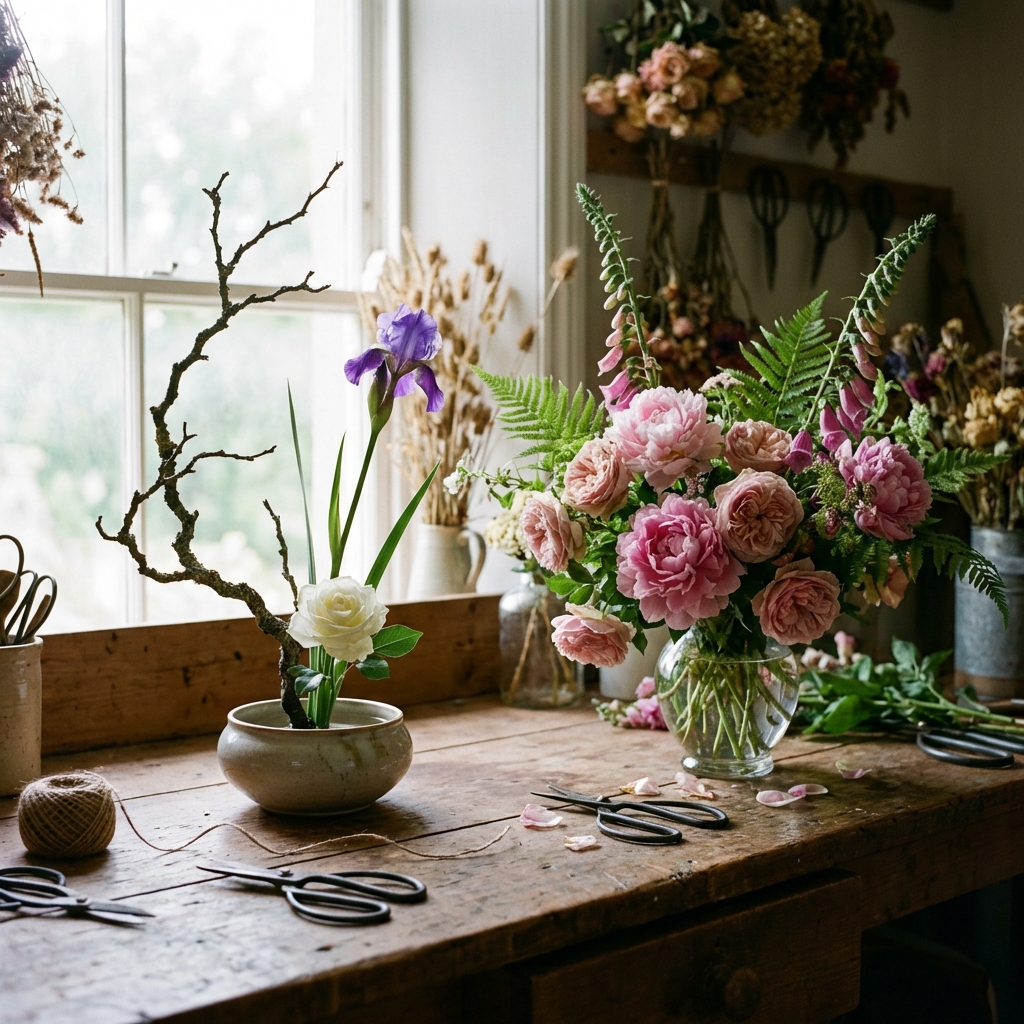
Featured Image Suggestion: Beautiful flower arrangement in natural light—British garden style with roses, sweet peas, and greenery in a rustic ceramic jug. Warm, inviting, achievable aesthetic.
Ruth Naomi
Community & Lifestyle LeadRuth is passionate about uncovering the stories that connect communities and celebrate local culture.

