

Faith in the Modern City: Reflections on Leeds Minster
Sacred Spaces in Busy Places
Walking into Leeds Minster, the noise of the city immediately fades. It's not just the thick stone walls; it's the weight of history and prayer that seems to hang in the air.
A Living Monument: The Story of Leeds Minster
Leeds Minster, originally known as the Parish Church of Saint Peter-at-Leeds, stands as one of the city's oldest and most significant buildings. The current structure, built between 1838 and 1841, is a masterpiece of Gothic Revival architecture designed by architect R.D. Chantrell. However, its roots stretch back much further—a church has stood on this site since at least the 7th century, making it a continuous site of Christian worship for over 1,300 years.
The building received its designation as Leeds Minster in 2012, recognizing its central role in the spiritual and civic life of the city. Unlike cathedrals, which are the seat of a bishop, a minster is a church with a particular missionary or pastoral responsibility. Leeds Minster serves not just as a place of worship but as a community hub—hosting concerts, art exhibitions, homeless services, and cultural events that bridge the sacred and the secular.
Standing in Millennium Square in the heart of Leeds city center, the Minster's gothic spire dominates the skyline, a reminder that even in our modern, bustling city, there remains space for contemplation, beauty, and transcendence. Its ornate interior features stunning Victorian stained glass windows, intricate wood carvings, and one of the finest church organs in Northern England—a 1841 Gray & Davison instrument that continues to fill the vaulted space with music.
The Tango of Tradition and Modernity
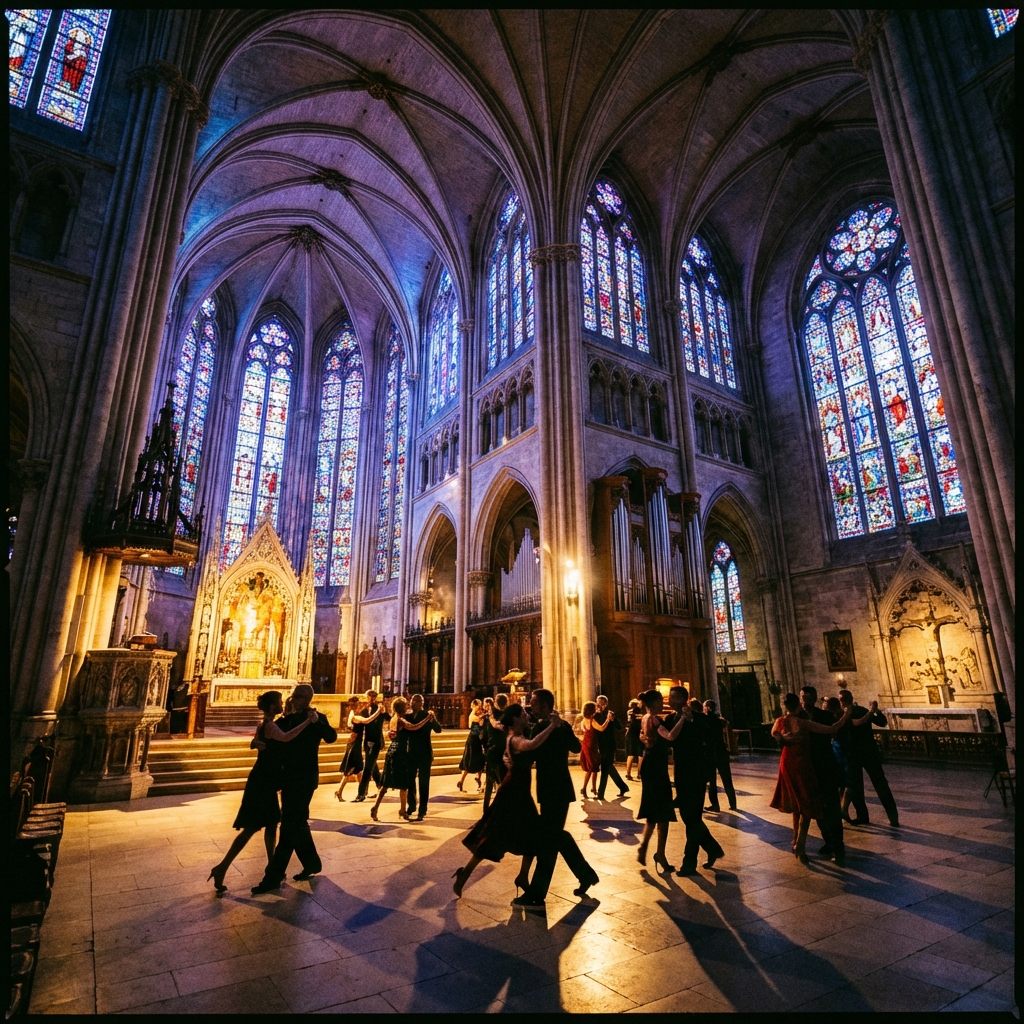
I was struck recently by an upcoming event at the Minster: "Seven Sins of Tango"—a tango performance in this sacred space. At first glance, it seems at odds with a place of worship. But look deeper. Faith has always danced with culture. The church isn't a museum for saints; it's a living, breathing space where human passion—in all its forms—can be expressed.
This isn't unprecedented. Throughout history, cathedrals and minsters have served as venues for music, theater, and art that engage with the full spectrum of human experience. From medieval mystery plays performed in church naves to contemporary art installations in ancient sanctuaries, sacred spaces have long provided stages for cultural expression.
A Brief History of Tango: From the Streets to Sacred Halls
Tango's journey from the brothels and tenements of Buenos Aires to the grand concert halls of the world mirrors humanity's eternal struggle between the sacred and profane. Understanding tango's history helps us appreciate why it belongs in a place like Leeds Minster.
The Birth in Buenos Aires (1880s-1900s)
Tango emerged in the late 19th century in the port neighborhoods of Buenos Aires and Montevideo, born from a cultural melting pot of European immigrants (especially Italian and Spanish), African rhythms, and indigenous influences. The dance developed in:
- Conventillos: Overcrowded tenement houses where diverse cultures mixed
- Bordellos and bars: Where working-class men danced with each other or with prostitutes, practicing before approaching women
- The streets: Where the dispossessed found expression and dignity through movement
The music combined European violin and piano with the bandoneón (a German concertina brought by immigrants), African candombe rhythms, and habanera from Cuba. The early lyrics were often crude, dealing with poverty, betrayal, and lost love—themes of struggle familiar to the urban poor.
From Sin to Sophistication (1910s-1930s)
Tango's transformation mirrors a redemption story:
- Parisian Acceptance (1913): When tango reached Paris, it was sanitized and romanticized. European high society embraced it, giving it legitimacy.
- Return to Buenos Aires: Now validated by Europe, tango was finally accepted by Argentina's upper classes. The "Golden Age" began.
- Carlos Gardel: The legendary singer transformed tango from dance music to an art form. His tragic death in 1935 cemented his mythical status—"Gardel sings better every day," say Argentinians.
Decline and Revival (1950s-1980s)
Military dictatorships in Argentina viewed tango gatherings as potential sites of resistance and suppressed the dance. By the 1970s, tango seemed destined for museums. Then came an unexpected renaissance:
- "Tango Argentino" (1983): This stage show took Paris and Broadway by storm, introducing a new generation to tango's power
- Astor Piazzolla: His "nuevo tango" fused traditional tango with jazz and classical music, bringing intellectual respectability
- Global Spread: By the 1990s, tango communities existed worldwide—from Tokyo to Helsinki to Leeds
Tango's Spiritual Dimension
What makes tango appropriate for a sacred space? Consider these spiritual elements:
- Abrazo (The Embrace): The close hold requires trust, vulnerability, and connection—themes central to faith
- Musicality: Tango demands deep listening, being present in the moment—a form of meditation
- Cabeceo (The Nod): The traditional invitation to dance is a silent, respectful communication—consent without words
- Suffering and Joy: Tango expresses both tristeza (sadness) and celebration, acknowledging life's full emotional spectrum
The Argentine writer Jorge Luis Borges wrote: "Tango is a direct expression of something that poets have often tried to state in words: the belief that fighting is a joy." This duality of struggle and beauty resonates with spiritual journeys.
Seven Sins of Tango: A Theological Dance
The title "Seven Sins of Tango" playfully references the seven deadly sins, but tango transcends this framework. Where traditional teaching sees temptation, tango sees humanity:
- Pride → Dignity: In the slums where tango was born, the dance gave people dignity
- Envy → Aspiration: The desire to dance better drives artistic growth
- Lust → Passion: The sensuality of tango celebrates human connection, not exploitation
- Wrath → Intensity: The fierce musicality channels emotion into art
Hosting events like this in Leeds Minster acknowledges that spirituality encompasses all of human experience—not just the sanitized parts.
What Would Jesus Do?
Some might ask, "Would Jesus attend a Tango concert?" It's a valid question for the faithful. Looking at the scriptures, we see Jesus was often criticized for where he spent his time and who he dined with. He didn't stay in the synagogue; he went to weddings (John 2), dinner parties, and gathered with all kinds of people in their daily lives. He embraced life, joy, and community.
"The Son of Man came eating and drinking, and they say, 'Here is a glutton and a drunkard, a friend of tax collectors and sinners.' But wisdom is proved right by her deeds."
— Matthew 11:19
Hosting events like this opens the church doors to people who might never otherwise step inside. It turns the Minster into a true community hub, breaking down barriers between the "sacred" and the "secular".
Who is this for?
You don't have to be religious to appreciate the Minster. This space welcomes everyone:
- Architecture Enthusiasts & Curious Minds: It's a masterpiece of the Gothic Revival style and a treasure trove of Leeds history.
- Music Lovers: From the famous choir to special tango concerts, the acoustics make it a bucket-list venue.
- Seekers of Solitude: In a world that never stops, having a free, quiet place to just sit is a radical act of self-care.
- Culture Explorers: The Minster regularly hosts art exhibitions, poetry readings, and performances that engage with contemporary issues through a spiritual lens.
References
- Leeds Minster Official Website
- Historic England – Leeds Parish Church (Grade I Listed Building)
- BBC – The Story of Tango
- The Guardian – Tango: The Dance That Conquered the World
- Encyclopedia Britannica – Tango: History and Cultural Significance
- Church Times – Cathedrals and the Arts: Sacred Spaces for Cultural Expression
Julian Cross
Community ContributorJulian writes about spirituality, community, and finding peace in urban life.

Braving the Cold: Scottish Highlands Winter Adventure