

Birmingham: From Industrial Engine to Cultural Powerhouse

Birmingham: From Industrial Engine to Cultural Powerhouse
Here's what most people don't know about Birmingham: Britain's second-largest city has more miles of canals than Venice, invented the Balti curry, was birthplace of heavy metal, and now boasts more Michelin-starred restaurants than any UK city outside London. Yet Birmingham remains criminally underrated, overshadowed by Manchester's swagger and London's dominance.
The numbers tell the story: 1.15 million residents, 42% under 30 (youngest major UK city), £2.2 billion city center regeneration, 140,000 daily visitors to New Street Station (busier than Manchester Piccadilly). Birmingham will be 49 minutes from London when HS2 completes, making it Europe's best-connected city outside the capital.
But statistics miss what makes Birmingham essential: genuine multiculturalism (not performative diversity), unpretentious creativity, industrial heritage transformed into cultural assets, and a food scene that reflects global Birmingham better than almost anywhere. This is Britain's most authentically diverse city—and it doesn't apologize for it.
This guide explores Birmingham beyond misconceptions: the Jewellery Quarter's craft legacy, canal networks rivaling European capitals, music heritage spanning Black Sabbath to UB40, and why this unsung city deserves your attention.
The Workshop of the World: Industrial Heritage
From Metalwork to Empire
Birmingham's wealth came from making things. By 1770, the city was Britain's industrial powerhouse—Matthew Boulton's Soho Manufactury employed 1,000 workers producing buckles, buttons, and silverware. James Watt perfected the steam engine here, sparking the Industrial Revolution. By 1900, Birmingham manufactured 40% of Britain's jewelry, guns for the Empire, and precision engineering that armed two World Wars.
The legacy remains visible everywhere: Victorian warehouses lining canals, red-brick factories converted to loft apartments, the Jewellery Quarter's workshops where craftspeople still practice 200-year-old skills.
The Jewellery Quarter: 250 Years of Craft
Walk through the Jewellery Quarter and you're walking through living industrial history. Since 1760, this compact square mile has produced 40% of UK jewelry. At its peak (1900s), 70,000 workers operated from 200+ factories. Today, 500+ jewelry businesses still operate here—some family-run for generations.
Must-visit:
- Museum of the Jewellery Quarter: Preserved 1900s workshop, tools still in place, FREE entry
- Independent makers: Watch silversmiths, goldsmiths, enamellers work
- Coffin Works: Newman Brothers' 1894 coffin furniture factory (yes, really)
- St. Paul's Square: Georgian townhouses, cafes, galleries
Canal Network: More Than Venice
Birmingham has 35 miles of canals—more than Venice's 26 miles. These 18th/19th-century waterways carried coal, iron, manufactured goods across Britain. When railways arrived, canals declined. By 1950s, they were derelict, polluted, forgotten.
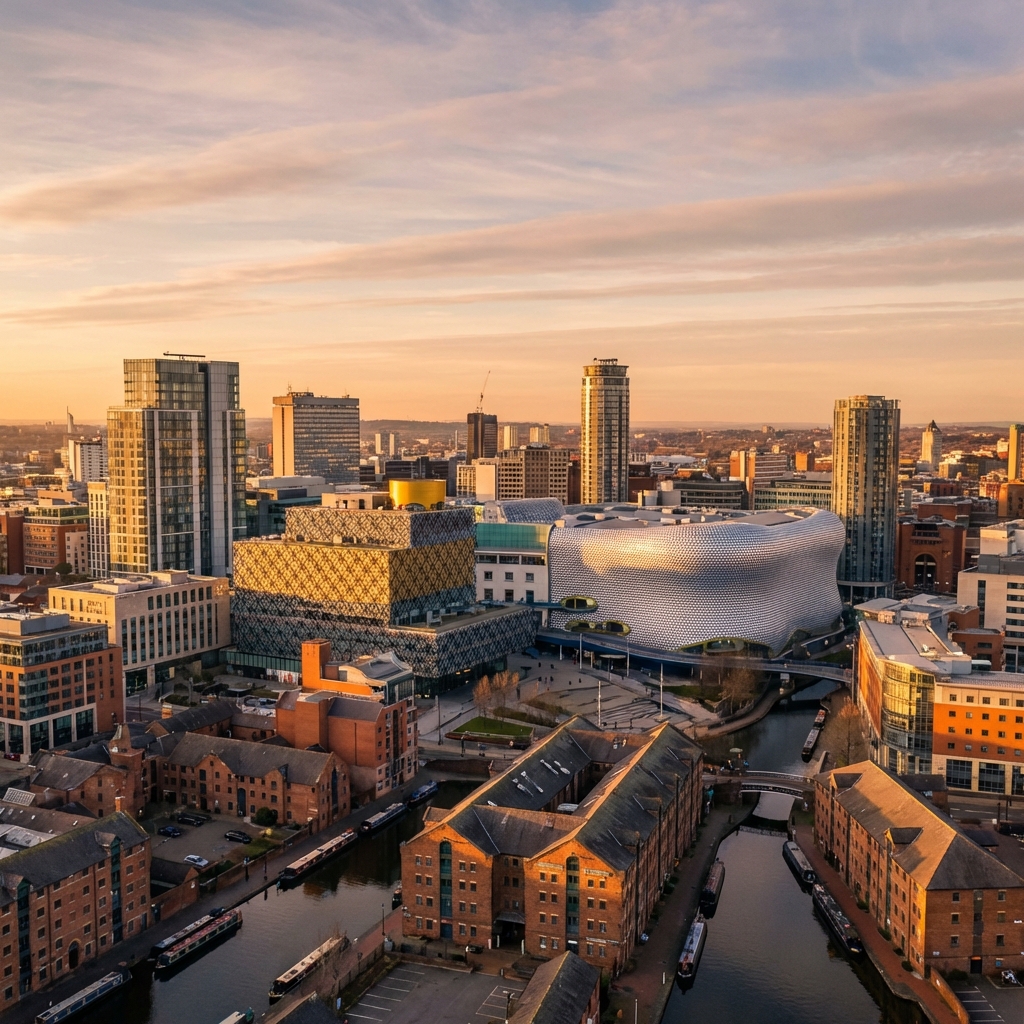
Then came regeneration. 1980s-2000s investment transformed canals into Birmingham's greatest asset: Brindleyplace (offices, restaurants, National Sea Life Centre), Gas Street Basin (narrowboats, waterside dining), Mailbox (luxury shopping), and 100+ miles of towpath walks through the city.
Canal highlights:
- Gas Street Basin: Historic canal junction, colorful narrowboats, waterside bars
- Brindleyplace: Modern canalside quarter, outdoor events
- Towpath walks: Escape city center in minutes, surprisingly peaceful
- Canal boat tours: Sherborne Wharf offers guided trips
From Black Sabbath to Bhangra: Music Heritage
Heavy Metal Birthplace
February 13, 1970: Black Sabbath released their self-titled debut album. Recorded in a single 12-hour session, it invented heavy metal. Four working-class kids from Aston—Tony Iommi, Ozzy Osbourne, Geezer Butler, Bill Ward—created a darker, heavier sound reflecting industrial Birmingham's bleak reality.
Impact: 100 million albums sold, every metal band since owes debt to Sabbath's blueprint. Birmingham gets less credit than it deserves for birthing an entire genre.
Reggae, Ska, and UB40
1978: Eight Birmingham musicians—Black, white, mixed—formed UB40 (named after unemployment benefit form). Their multicultural lineup reflected Birmingham's diversity decades before "representation" became buzzword. "Red Red Wine" (1983) topped charts globally. 70+ million albums sold made them Britain's most successful reggae band.
Birmingham's Caribbean community established by 1950s Windrush generation created UK's first reggae scenes, sound system culture, and the bhangra fusion movement (1980s-90s) blending Punjabi music with Western pop.
Duran Duran and New Romantic
1978-1985: Birmingham gave birth to New Romantic movement alongside London. Duran Duran (formed at Birmingham's Rum Runner nightclub) defined 1980s pop: MTV-ready videos, synthesizers, glamour. 100+ million records sold.
Meanwhile, Dexy's Midnight Runners ("Come On Eileen"), The Beat, and The Streets (2000s garage/grime) kept Birmingham on music maps.
Today's Scene
Birmingham's 2020s music scene thrives across genres:
- Grime/hip-hop: Mist, Lady Leshurr, Jaykae represent Birmingham's voice
- Indie/alternative: Swim Deep, JAWS, Peace emerged from Digbeth DIY scene
- Electronic: Warehouse parties in industrial spaces
- Live venues: O2 Academy (major tours), Hare & Hounds (grassroots), Arena Birmingham (20,000 capacity)
From Balti to Michelin Stars: Food Revolution
Balti Triangle: Birmingham's Invention
Here's a fact: Birmingham invented the Balti curry in the 1970s. Pakistani immigrants in Sparkbrook/Balsall Heath created this one-pot curry cooked and served in a pressed-steel Balti bowl. It doesn't exist in Pakistan—it's uniquely Birmingham.
The Balti Triangle (Ladypool Road area) became curry pilgrimage site. At peak (1990s), 50+ Balti houses operated. Today, classics remain:
- Adil's: No-frills, BYO alcohol, legendary Baltis since 1977
- Al Frash: Royal family dined here, still authentic
- Shababs: Late-night favorite, open til 4am
Balti protocol: Order naan bread, expect sizzling metal bowl, eat with bread not rice.
Michelin-Starred Excellence
Birmingham now has 6 Michelin-starred restaurants—more than Manchester, Leeds, Liverpool combined:
- Adam's (⭐): Adam Stokes' modern British fine dining
- Opheem (⭐): Aktar Islam's progressive Indian cuisine
- Purnell's (⭐): Glynn Purnell's "yam yam" (Black Country slang) fine dining
- Simpsons (⭐): Classic British, Edgbaston mansion
- Carters of Moseley (⭐): Neighborhood gem
- The Cross at Kenilworth (⭐): Just outside Birmingham
Global Birmingham on a Plate
Birmingham's 42% BAME population creates Britain's most authentic international food scene:
- Chinese Quarter: Original Chinatown (1950s), authentic Cantonese
- Caribbean: Jerk chicken, goat curry, Jamaican patties
- Middle Eastern: Lebanese, Syrian, Iraqi communities
- Eastern European: Polish delis, Romanian cafes
- Vegetarian/vegan: Large Gujarati/Jain community = incredible meat-free options
Cultural Landmarks: World-Class and Free
Birmingham Museum & Art Gallery
FREE admission to world's largest Pre-Raphaelite collection: Rossetti, Burne-Jones, Millais. Also: Ancient Egyptian artifacts, Staffordshire Hoard (largest Anglo-Saxon gold hoard ever found), contemporary art. 800,000 annual visitors.
Library of Birmingham
Opened 2013, Europe's largest public library: 10 floors, 400,000 books, Shakespeare Memorial Room (world's greatest Shakespeare collection), rooftop gardens, FREE exhibitions. Controversial £189m cost, but 2.4 million annual visitors proved worth.
Symphony Hall
Acoustically one of the world's finest concert venues, home to City of Birmingham Symphony Orchestra (CBSO). Under Simon Rattle (1980-1998), CBSO became internationally renowned. Hall's adjustable acoustic makes it versatile for classical, jazz, pop.
Ikon Gallery
FREE contemporary art in converted Gothic Revival school (Brindleyplace). Cutting-edge exhibitions, international artists. Part of Birmingham's uncommonly strong contemporary art scene.
Modern Regeneration: £2.2 Billion Transformation
Bullring: Retail Resurrection
2003 opening transformed Birmingham shopping: Selfridges' iconic building (bubble-wrap architecture, 15,000 aluminum discs), 160+ stores, 42 million annual visitors (one of Europe's busiest retail destinations).
New Street Station & Grand Central
2015 redevelopment: 140,000 daily passengers through transformed station, Grand Central shopping center above platforms, John Lewis flagship. Replaced Britain's most depressing station with light, space, commerce.
HS2: 49 Minutes from London
When HS2 completes, Birmingham becomes 49 minutes from London (currently 90 mins), 38 minutes from Manchester. Curzon Street station (opens 2030s) brings £1.5 billion private investment, 100,000 new jobs.
Neighborhoods: Where to Explore
Digbeth: Creative Quarter
Birmingham's coolest neighborhood: Victorian warehouses host street art, Custard Factory (independent shops, studios, cafes), Digbeth Dining Club (street food), warehouse parties, craft breweries. Gentrifying rapidly but retains grit.
Moseley: Bohemian Village
Leafy suburb 3 miles south: independent shops, live music pubs, farmers market, community festivals. Musicians, artists, families. Less polish than Chorlton (Manchester) or Chorlton (Leeds), more authentic.
Harborne: Gastropubs & Green Spaces
Middle-class suburb with canal towpath access, great pubs, proximity to University of Birmingham. Gateway to Cannon Hill Park, Edgbaston Reservoir.
Getting There & Around
Train: Birmingham New Street (direct from London Euston 1hr 30mins, Manchester 1hr 30mins, Liverpool 1hr 45mins)
Airport: Birmingham Airport (7 miles, train to New Street 10 mins)
Coach: National Express HQ (connections nationwide)
Local transport:
- Midland Metro: Tram to Wolverhampton, West Bromwich
- Buses: Extensive network (£4 day ticket)
- Walking: Compact city center, easily walkable
- Cycling: Canal towpaths = car-free routes
Practical Tips
- Weekend timing: Saturday best for markets, Sunday quieter
- Avoid: New Street Station rush hour (7-9am, 4:30-6:30pm)
- Budget: Museums FREE, street food £5-10, Michelin dinner £80-150
- Accommodation: Boutique hotels in Jewellery Quarter, chains near New Street
- Local slang: "Bostin" = excellent, "Bab" = term of endearment
Why Birmingham Matters
Birmingham doesn't sell itself well. It lacks Manchester's branding, Liverpool's Beatles narrative, Newcastle's Geordie Shore notoriety. But look closer: this is Britain's most authentically multicultural city, where industrial heritage becomes cultural asset, where working-class creativity invents Balti curries and heavy metal, where world-class museums charge nothing.
The city that powered the Industrial Revolution is reinventing itself—again. HS2 will accelerate transformation, but Birmingham's strengths already exist: genuine diversity, creative energy, unpretentious excellence. It just needed people to pay attention.
Visit before everyone else catches on.
References & Resources
Essential websites:
- Visit Birmingham: Official tourism site
- Birmingham Museums Trust: Free museums and galleries
- Library of Birmingham: Events and exhibitions
- The Jewellery Quarter: Shopping and history
Culture & Arts:
- Birmingham Hippodrome: Ballet, opera, musicals
- Town Hall & Symphony Hall: Classical music
- Ikon Gallery: Contemporary art
- Digbeth: Creative quarter
Food & Drink:
Transport:
Ruth Naomi
Community & Lifestyle LeadRuth is passionate about uncovering the stories that connect communities and celebrate local culture.