

A Beginner's Guide to Dungeons & Dragons: How to Start Your Adventure

What is Dungeons & Dragons?
Dungeons & Dragons (D&D) is the world's most popular tabletop role-playing game, where you and your friends create characters and embark on collaborative storytelling adventures. One person acts as the Dungeon Master (DM), who narrates the story and controls the world, while the other players control their individual characters navigating challenges, solving mysteries, and battling monsters.
Unlike video games, D&D has no predetermined path—your choices truly matter, and the story unfolds based on your decisions and dice rolls. It's part improvisational theatre, part strategy game, and entirely collaborative storytelling.
What You Need to Get Started
- Players: Ideally 3-6 people (including a Dungeon Master)
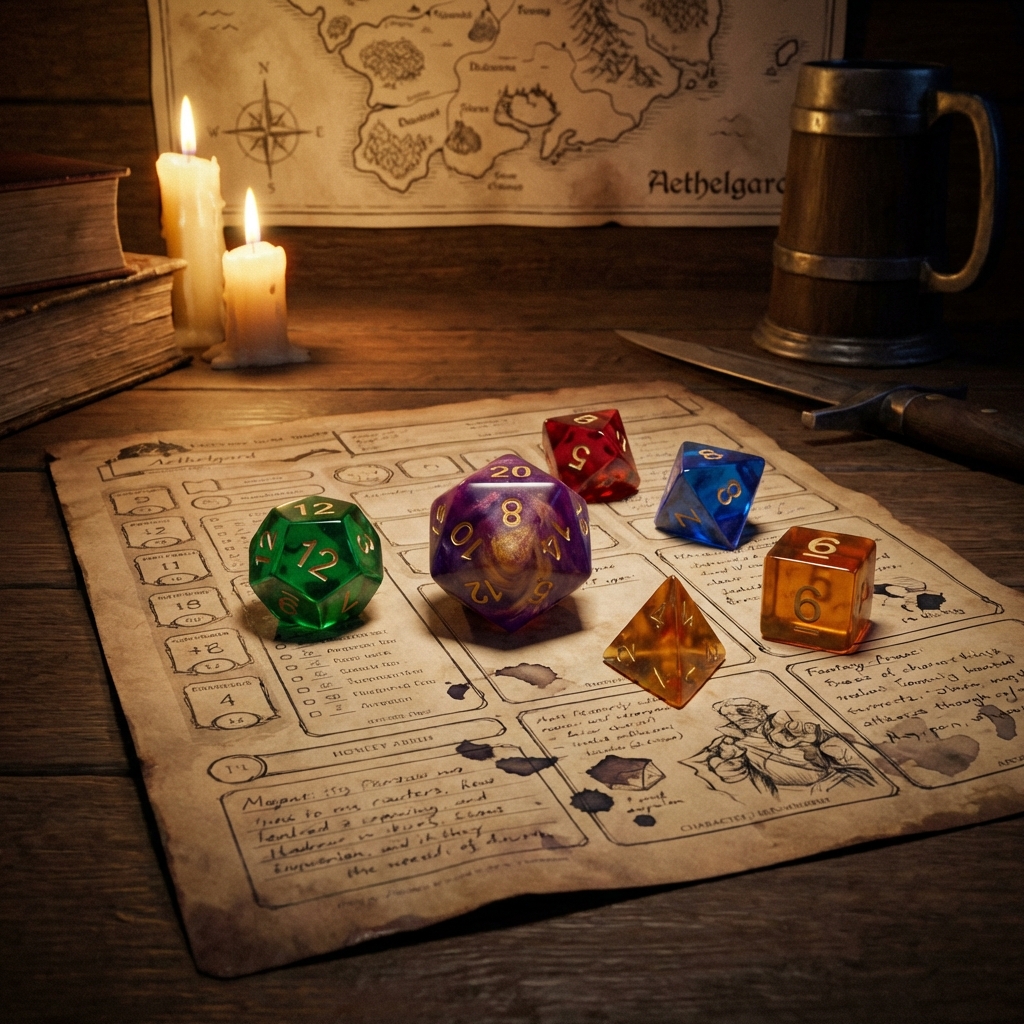
- Dice: A set of polyhedral dice (d4, d6, d8, d10, d12, d20)
- Character Sheets: To track your character's abilities and inventory
- Rulebooks: The Player's Handbook is essential; the Dungeon Master's Guide and Monster Manual are helpful for DMs
- Imagination: The most important ingredient!
For absolute beginners, the D&D Starter Set or Essentials Kit includes everything you need: dice, pre-made characters, a beginner-friendly adventure, and simplified rules.
Creating Your Character
1. Choose a Race
Your character's race determines their ancestry and provides certain abilities. Popular choices include:
- Humans: Versatile and adaptable
- Elves: Graceful and long-lived, with keen senses
- Dwarves: Sturdy and resilient mountain folk
- Halflings: Small, lucky, and remarkably brave
- Dragonborn: Draconic humanoids with breath weapons
2. Choose a Class
Your class defines your role in the party and your abilities. Common classes include:
- Fighter: Master of weapons and armor (beginner-friendly)
- Wizard: Scholarly spellcaster with powerful magic
- Rogue: Sneaky expert in stealth and locks
- Cleric: Divine spellcaster and healer
- Ranger: Wilderness expert and tracker
- Barbarian: Fierce warrior who channels rage
3. Determine Ability Scores
Six core abilities define your character:
- Strength: Physical power (melee combat, athletics)
- Dexterity: Agility and reflexes (ranged attacks, stealth)
- Constitution: Endurance and health
- Intelligence: Reasoning and memory (wizard spells)
- Wisdom: Awareness and insight (cleric/druid spells)
- Charisma: Force of personality (persuasion, leadership)
4. Add Personality
Give your character depth! Create a backstory, personality traits, ideals, bonds, and flaws. Are they a noble knight seeking redemption? A mischievous rogue with a heart of gold? Your character's personality makes the game memorable.
How to Play: The Basics
The Core Mechanic: d20 Rolls
Most actions in D&D are resolved by rolling a 20-sided die (d20) and adding relevant modifiers:
- Roll d20
- Add relevant ability modifier
- Add proficiency bonus (if applicable)
- Compare to target number (Difficulty Class or DC)
Example: To climb a wall (DC 15), you roll d20 + Strength modifier + Athletics proficiency (if you have it). If the total equals or exceeds 15, you succeed!
Combat
When initiative is called, combat unfolds in turns:
- Initiative: Everyone rolls d20 + Dexterity to determine turn order
- Your Turn: On your turn, you can move (usually 30 feet), take an action (attack, cast spell, etc.), and potentially use a bonus action
- Attack Rolls: Roll d20 + attack modifier vs. target's Armor Class (AC)
- Damage Rolls: If you hit, roll weapon damage dice (e.g., longsword = 1d8 + Strength)
Skill Checks
Want to persuade a guard, investigate a crime scene, or sneak past enemies? Make a skill check using the relevant ability and proficiency.
Tips for New Players
Embrace Creativity
D&D rewards creative thinking. If the rulebook doesn't explicitly cover your idea, ask your DM! Want to swing from a chandelier, disguise yourself as a guard, or befriend a dragon? Try it!
Work as a Team
D&D is collaborative. Support your fellow adventurers, let everyone have moments to shine, and remember that the best stories come from working together.
Don't Fear Failure
Failed rolls often create the most memorable moments. When your wizard botches a spell or your rogue trips an alarm, embrace the chaos—it makes for better stories!
Ask Questions
New to the rules? Ask! Experienced players and DMs are usually eager to help. No one expects you to know everything on Day 1.
Session Zero is Important
Before starting your campaign, discuss expectations with your group: What kind of story do you want? What tone (serious, comedic, horror)? What topics are off-limits? Clear communication prevents problems later.
Finding a Group
Don't have friends who play? No problem! Many local game shops host D&D Adventurers League sessions for newcomers. Check our Events page for D&D sessions in your area. Online platforms like Roll20 and Foundry VTT also connect players worldwide for virtual tabletop gaming.
Common Beginner Mistakes
- Lone Wolf Syndrome: D&D works best when characters cooperate. Don't isolate yourself from the party.
- Overthinking Builds: Your first character doesn't need perfect optimization. Simple concepts often work best.
- Arguing with the DM: The DM makes final rulings. Discuss rules politely after the session, not during.
- Not Taking Notes: D&D campaigns involve complex plots. Jot down important NPCs, locations, and quests.
- Min-Maxing Too Hard: A character with personality flaws is more interesting than a perfect stat block.
Beyond the Basics
Multiclassing
Once comfortable with the game, you can combine classes (e.g., Fighter/Wizard) for unique builds. Save this for your second or third character!
Homebrew Content
Many groups create custom rules, races, and classes. Always check with your DM before using homebrew material from the internet.
Digital Tools
Apps like D&D Beyond simplify character creation and tracking. Digital dice rollers, music playlists, and virtual tabletops enhance the experience.
References & Resources
- D&D Beyond: Official Digital Toolset
- Wizards of the Coast: Free Basic Rules
- D&D Beyond YouTube: Tutorial Videos
- Critical Role: Popular D&D Actual Play Series
- r/DnD: Community Support and Resources
Essential Reading
- Player's Handbook (5th Edition) - The core rulebook
- Xanathar's Guide to Everything - Expanded options for players
- Tasha's Cauldron of Everything - More customization options
Your Adventure Begins
Dungeons & Dragons is more than a game—it's collaborative storytelling, problem-solving, and friendship around a table. Whether you're exploring haunted dungeons, negotiating with dragons, or simply sharing laughs with friends, D&D creates memories that last a lifetime.
Grab some dice, gather your friends, and embark on your first adventure. The realm of imagination awaits, and your story is just beginning. Roll for initiative!
Julian Cross
Games & Strategy WriterJulian brings analytical thinking and community gaming experience to help newcomers master classic games.

