
The Art of Tasting: How to Drink Like a Pro

From Banquets to Blind Tastings: A History of Evaluation
While humans have enjoyed alcohol for millennia, the way we taste it has evolved dramatically. What was once purely communal drinking has evolved into the sophisticated sensory analysis we know today.
18th Century: The Enlightenment of the Palate
In the 1700s, wine began to separate itself from simple sustenance. Wealthy European elites hosted elaborate banquets where wines were not just consumed but critiqued as a symbol of status and education. This era saw the first scientific approaches to understanding fermentation and flavour, though simpler spirits like rum and brandy were still largely consumed for effect in raucous taverns rather than analysed in crystal glasses.
19th Century: Industrialisation & Formalisation
The 1800s laid the groundwork for the modern connoisseur. As industrialisation improved glass production, the vessel became as important as the liquid. "Tasting notes" began to appear in trade journals. The rise of blending houses in Scotland meant that Master Blenders started treating whisky nosing as a high-stakes profession, distinct from the casual drinker. Meanwhile, wine tourism emerged, with enthusiasts travelling to vineyards specifically to taste at the source.
20th Century: The Science of Sensory Analysis
The 1900s brought rigorous structure. In 1976, the famous "Judgment of Paris" proved the value of blind tasting—where California wines beat French icons because judges couldn't see the labels. This century solidified the standard 4-step method (Look, Smell, Taste, Finish) we use today. Prohibition in the USA (1920-1933) created a temporary dark age, but its repeal sparked a cocktail renaissance that valued quality ingredients over high volume.
A World of Spirits: What People Taste
The beauty of tasting isn't just in the technique—it's in the diversity. Here is a globe-spanning guide to the most popular spirits and their homelands.
Whisky/Whiskey
- Scotland: Scotch Whisky (Single Malt, Blended). Brands: Johnnie Walker, Glenlivet, Laphroaig.
- Ireland: Irish Whiskey (typically triple-distilled, smooth). Brands: Jameson, Bushmills.
- United States: Bourbon (51%+ corn, sweet, vanilla notes), Rye (spicier). Brands: Jack Daniel's, Maker's Mark, Bulleit.
- Japan: Japanese Whisky (refined, delicate). Brands: Yamazaki, Hakushu, Nikka.
- Canada: Canadian Whisky (light, often blended). Brands: Crown Royal.
- India: Growing whisky market (Royal Challenge, Blender's Pride).
Gin
- Netherlands: The birthplace of "jenever" (genever), gin's predecessor.
- England: London Dry Gin (Tanqueray, Beefeater, Gordon's). The global standard.
- Spain: Mediterranean Gin (floral, citrus-forward).
- USA, Scotland, Japan: Craft gin movement with creative botanicals.
Vodka
- Russia: Vodka's spiritual home. Smirnoff (originally), Russian Standard.
- Poland: Żubrówka (bison grass vodka), Belvedere.
- Sweden: Absolut.
- France: Grey Goose.
- USA: Tito's Handmade Vodka.
Rum
- Jamaica: Bold, funky flavours (Appleton Estate, Wray & Nephew).
- Barbados: Smooth, complex (Mount Gay).
- Cuba: Light, mixable (Havana Club).
- Trinidad: Angostura.
- Puerto Rico: Bacardi (now based in Bermuda).
- Guyana: Rich, dark (El Dorado).
Tequila & Mezcal
- Mexico: The only country where tequila can legally be produced (blue agave, Jalisco region). Mezcal comes from various agave species and regions. Brands: Patrón, Don Julio, Ocho.
Brandy
- France: Cognac (Hennessy, Rémy Martin) and Armagnac from Southwest France. Calvados (apple brandy) from Normandy.
- Spain: Brandy de Jerez (aged in sherry casks).
- Peru & Chile: Pisco (grape brandy).
- Armenia: Ararat (Armenian brandy).
Drinking vs. Tasting: What's the Difference?
We've all been there: sipping a drink mindlessly while chatting with friends. There's nothing wrong with that. But tasting is an active pursuit. It implies intention. It's the difference between hearing a song in the background and listening to the lyrics.
Professional tasters (like those at the Wine & Spirit Education Trust) use a systematic approach to break down a spirit into its core components. The good news? You don't need a qualification to do it. You just need a glass and five minutes.
The 4 Steps to Professional Tasting
Follow this roadmap to unlock the secrets in your glass.
1. Appearance: The Look
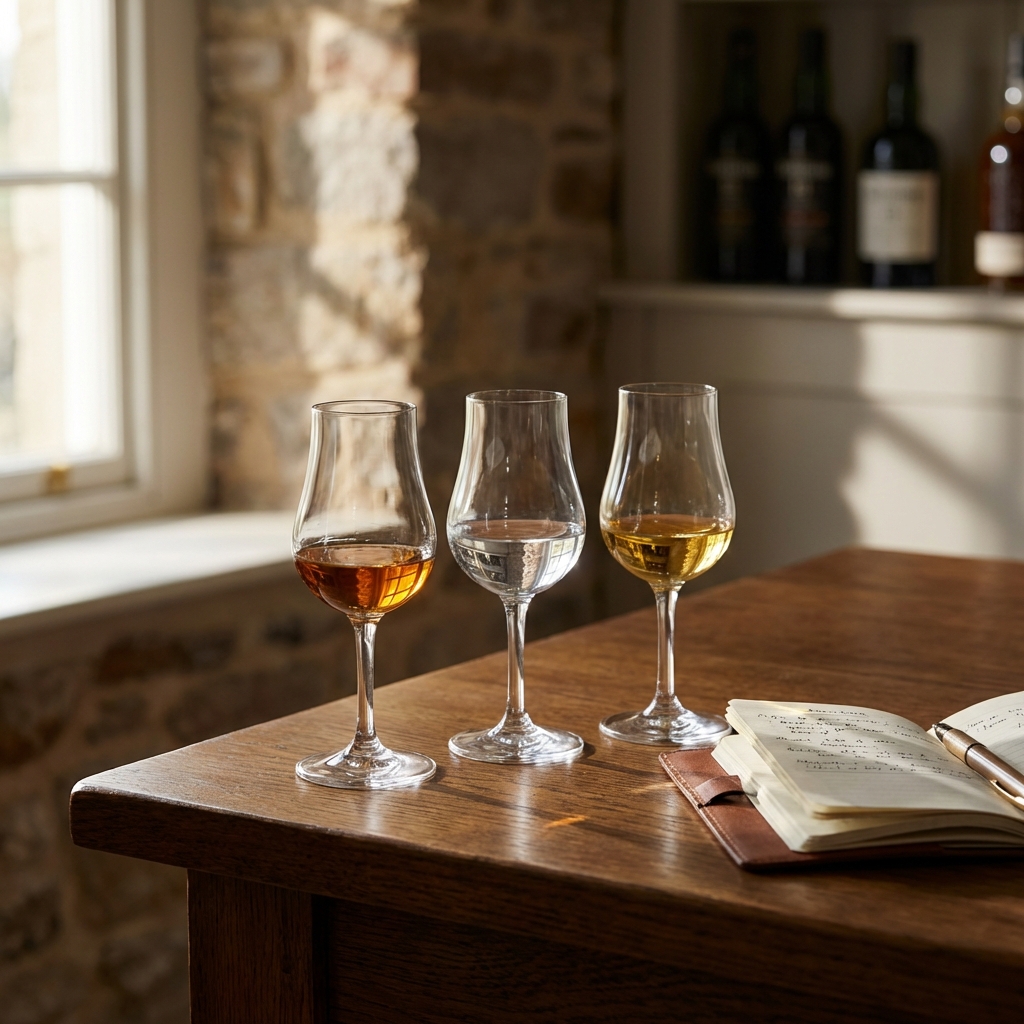
Hold your glass up to the light (preferably natural light) against a white background.
- Clarity: Is it crystal clear or hazy? Haze can imply a fault, though some craft spirits are non-chill filtered to keep flavour textures.
- Colour: Describe it precisely. Is that whisky "brown", or is it "deep amber with mahogany highlights"? Is that gin clear, or does it have a faint lemon hue from botanicals?
- Viscosity ("Legs"): Swirl the glass gently. Watch the droplets run down the side. Thick, slow-moving "legs" often indicate higher alcohol or sugar content.
2. Nose: The Aromas
Most of what we perceive as flavour is actually smell. Don't stick your nose right in immediately or the alcohol vapors will burn (anesthetize) your sensors.
- The Approach: Hold the glass a few inches from your nose. Breathe in gently with your mouth slightly open. Move it closer gradually.
- Identify Groups: Look for broad categories first.
- Fruit: Citrus, berries, dried fruit?
- Floral: Rose, heather, elderflower?
- Spice: Cinnamon, pepper, vanilla?
- Earth: Smoke, peat, leather, tobacco?
3. Palate: The Taste
Take a small sip—just enough to coat your tongue. Let it sit for a second. "Chew" the liquid slightly.
- Texture (Mouthfeel): Is it watery, silky, oily, or unctuous?
- Taste: Your tongue detects Sweet, Sour, Bitter, Salty, and Umami. Where does the sweetness hit? Is there a bitter finish?
- Flavour: This is where the aromas meet the taste. Confirm what you smelled. Did the vanilla on the nose turn into caramel on the tongue? Did the citrus scent become a bitter peel taste?
4. Finish: The Aftertaste
Swallow (or spit, if you're tasting many). How long does the flavour last? A "short" finish disappears instantly. A "long, complex" finish can evolve for minutes. High-quality spirits almost always have a longer finish.
Developing Your Palate
You don't need to be born with a special nose. You just need to build your smell-vocabulary.
- Smell Everything: At the supermarket, smell the fresh basil, the ground coffee, the vanilla pods, the leather handbags. You can't recognise "star anise" in a gin if you've never smelled star anise in real life.
- Taste Comparatively: Don't just drink one whisky. Pour two side-by-side. The differences will pop out immediately.
- Write It Down: Keeping a tasting journal forces you to find words for sensations. It cements the memory.
Next Steps
Ready to practice? Visit our Events page to find local tasting evenings, or head to one of our recommended Cocktail Bars to put your skills to the test.
Julian Cross
Food & Drink EditorJulian writes about spirituality, community, and finding peace in urban life.

Valentine's Day 2026: History, Psychology & How to Celebrate on Your Terms